
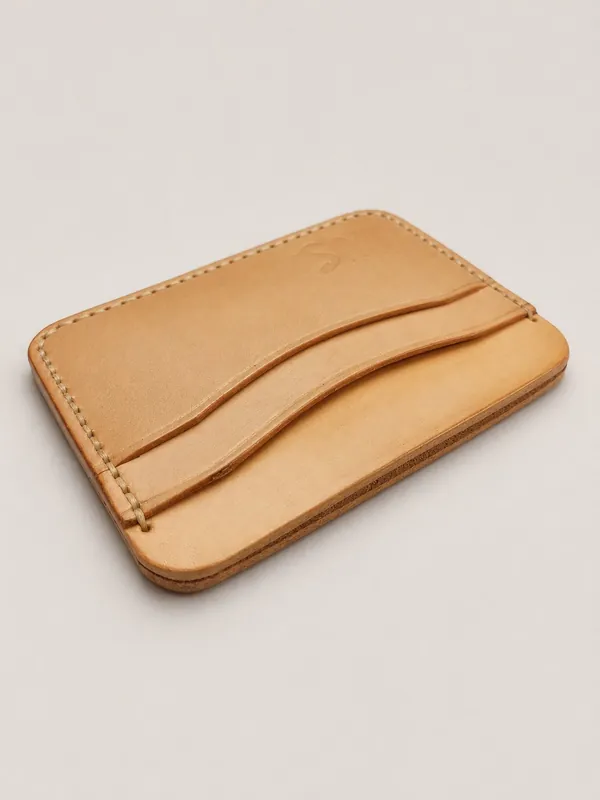
The question “card holder or wallet?” is more specific than it seems. It is not about style or trends, but a practical decision: what you carry every day, how you pay and how much bulk you are willing to accept in your pocket. Before looking at materials or particular models, it helps to be clear about the answers to those three questions.
Both formats can be made from vegetable-tanned leather and worked by hand with the same level of care. The difference between a card holder and a wallet is not quality, but function. Choosing the wrong format—even an excellent piece—is the easiest mistake to make when buying without trying it first.
The practical difference between the two formats
A card holder is a compact case designed to carry cards with easy access. The simplest models have one or two slots and fit comfortably in a front trouser pocket without creating bulk. Slightly larger models may add room for one or two folded banknotes, but without a dedicated cash compartment.
A wallet—bifold, trifold or flap-style—is intended to carry cards, banknotes and, depending on the model, coins or documents as well. It has more compartments, takes up more space and weighs a little more. It is the traditional format and the best everyday solution for someone who carries a lot or needs flexibility to change what they carry.
The size difference between the two formats is more noticeable than it usually appears in product photographs. A well-designed card holder is a finger's thickness or less; a bifold with six cards and some banknotes can easily be three times as thick. In a front trouser pocket, you feel that difference with every movement.
When a card holder works better for everyday life
A card holder suits you if you carry few cards—the ones you actually use, not those kept just in case—and pay mainly by card or phone. If you carry cash occasionally and can manage with a folded banknote in the same slot, you do not need more either.
It is also the logical choice if you carry the accessory in your front trouser pocket and find bulk annoying. A simple handmade leather card holder weighs very little, does not distort the fabric and provides quick access to what you actually use. For someone working in settings where having a lot in their pocket is uncomfortable—standing, constantly moving, wearing fitted clothing—a compact card holder is hard to beat for functionality.
Vegetable-tanned leather in a card holder often behaves in a particular way during the first few weeks: it starts out firmer and gradually molds to the cards with use. This is a characteristic of the material, not a defect.
When carrying a wallet makes more sense
A wallet is the more reasonable option if you regularly carry six or more cards, frequently use cash or need to carry documents you do not want to fold. The same applies if you change the contents throughout the day—sometimes more cards, sometimes loose banknotes—and need the flexibility of separate compartments.
For travel, a wallet remains more practical: transport cards, banknotes of different denominations and identity documents have their own places and do not get mixed together. Although a card holder may meet everyday needs in the city, many people choose to switch formats for longer trips.
A handmade leather bifold wallet also has more presence when you take it out: it has more substance and visual weight. For some people that matters; for others, it is exactly what they want to avoid.
The options in between
Some formats handle the gray area between card holder and wallet well. A slim wallet has card slots and space for banknotes without the additional compartments of a classic bifold. It is thinner than a bifold but has more capacity than a dedicated card holder.
Another intermediate option is a wallet with an integrated card holder: a bifold piece in which the card slots are the central feature, with space for banknotes on one side. This is a solution for someone who needs to carry cards and banknotes but wants access to cards as quickly as with a card holder.
None of these intermediate options is universally better. Everything depends on what you carry and how you prefer to organize it; the best format is the one that means you almost never have to rummage to find what you need.
The criterion that always works when deciding
Before choosing between a card holder and a wallet, try this simple exercise: empty your current wallet and separate what you have used in the past week from what you carry “just in case.” What you actually use each week defines the format you need. Everything else is taking up space without adding anything.
If what you really use is three or four cards and your phone for payments, a compact leather card holder handles everyday life effortlessly. If you use a transport card, two credit cards and your DNI identity card every day, and need room for banknotes, a wallet with more compartments will mean less stress and less time searching for what you need at the wrong moment.
In the Woodman Studio shop, you can see the available card holder and wallet models in vegetable-tanned leather. If you are unsure which format best suits your particular use, write via WhatsApp or use the contact page to ask before deciding.
Not sure whether you need a card holder or a wallet? Tell Oleg what you carry, and he will guide you before you have to choose: get in touch via WhatsApp.
Frequently asked questions
What is the difference between a card holder and a wallet?
A card holder is optimized for carrying cards with quick access and minimal bulk. A wallet has more compartments and includes space for banknotes and, depending on the model, coins and documents. The difference is functional: the card holder prioritizes compactness; the wallet, capacity.
Can a card holder completely replace a wallet?
It depends on your habits. If you almost always pay by card or phone and rarely carry cash, a card holder handles everyday life without a problem. If you frequently need to carry banknotes, coins or documents, a wallet remains more practical for those situations.
Are vegetable-tanned leather card holders durable enough for daily use?
Vegetable-tanned leather with properly finished stitching is intended for everyday use. This type of leather usually has an initial breaking-in period during which it is stiffer; regular use gradually helps it adapt. For maintenance, the safest approach is a soft, dry cloth and following the artisan's instructions for each piece's finish; consult the Care section.
Which format is best for a front trouser pocket?
A compact card holder. It is the thinnest, lightest format, designed to fit in a front pocket without creating bulk or getting in the way when walking. Slim wallets also work well in a front pocket if you need slightly more capacity.
Does Woodman Studio offer both card holders and wallets?
You can see which formats are currently available in the shop. It is worth confirming availability and specific measurements by contacting the studio directly before deciding.