
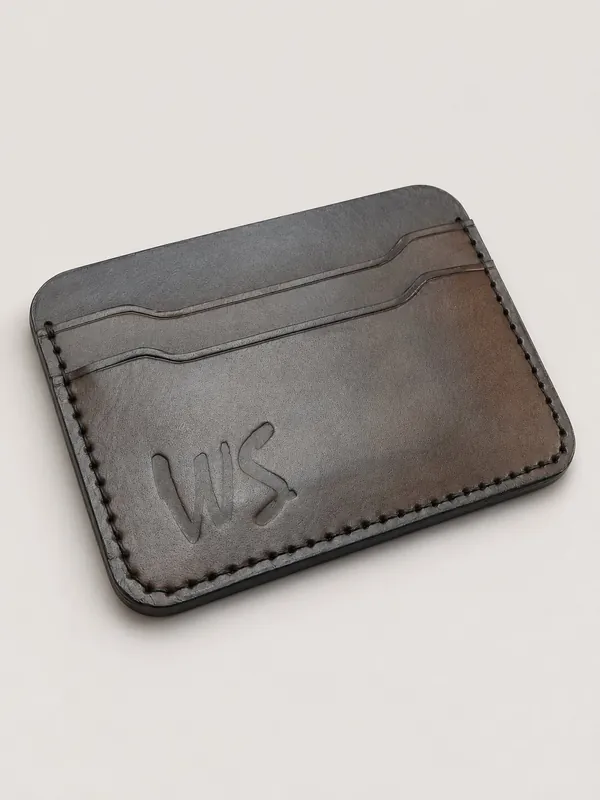
The discussion of slim wallets versus classic leather wallets has been circulating for years, but few comparisons address it honestly: each format has real advantages and real limitations, and the right answer is not the same for everyone. This article does not aim to persuade you to choose either one; it aims to give you the criteria to decide for yourself.
Both options can be made from vegetable-tanned leather and worked by hand with the same level of care and detail. The difference is not quality, but function. And the right function depends on one very specific fact: what you carry every day.
What a slim wallet is and how it differs from a classic bifold
A slim wallet—also called a thin or minimalist wallet—is a format designed to carry only what is necessary in the smallest possible space. It usually has between two and four card slots and space for banknotes, without the additional compartments of a classic bifold. When well designed, without overloaded slots, its loaded thickness can be around six to eight millimeters.
A classic bifold wallet has more compartments: several card slots, one or two banknote compartments, sometimes a pocket for coins or documents. It folds in half, making it thicker in your pocket but allowing it to organize more types of contents in the same accessory.
The difference in thickness between them, when loaded with the same contents, is more noticeable than photographs suggest. A bifold with eight cards and several banknotes can be three times as thick as a slim wallet holding the same contents arranged more tightly.
The real advantages of carrying a slim wallet
A slim wallet shines in a particular context: someone who carries few cards, usually pays by card or phone and wants an accessory they do not notice in their pocket. For that usage profile, reducing bulk has a direct impact on everyday comfort, especially when carried in a front trouser pocket.
Card access is also quicker in many slim wallet designs: with few slots and few cards in each, finding what you need takes less time. When you use the same two or three cards every day, there is nothing to check; you know exactly where everything is.
From the leather's perspective, a well-made slim wallet in vegetable-tanned leather has fewer stress points than a loaded bifold. Fewer contents, less pressure on the stitching and the leather at the edges. This guarantees nothing about durability—care and use matter too—but it is a factor worth considering.
Why the classic wallet remains irreplaceable for many
The classic bifold wallet has a simple argument: capacity and flexibility. If you carry six or more cards, cash regularly and sometimes loose documents, no slim wallet will handle that without requiring you to leave something behind or strain the slots beyond reason.
It is also the most practical format for someone whose contents change with the situation. On travel days or when carrying more things, a bifold accommodates more without becoming misshapen; a slim wallet starts feeling the extra pressure immediately. Many people use a slim wallet for everyday city life and keep a bifold for situations where they need more.
A classic handmade leather wallet also has more presence when you take it out. It has more substance and more weight in the hand. For someone who values that, a bifold has something a slim wallet cannot match; for someone who wants to remain discreet, it is exactly the reason to choose the opposite.
Direct comparison: what each format offers
| Criterion | Slim wallet | Classic wallet (bifold) |
|---|---|---|
| Thickness in pocket | Very thin (≈ 6–8 mm loaded) | Greater, depending on contents |
| Card capacity | 4–6 in compact models | 6–12 depending on slots |
| Space for banknotes | 1–2 folded banknotes | Dedicated banknote compartment |
| Coins | No | Only in models with a coin pocket |
| Front-pocket comfort | Very high | Medium-high |
| Quick card access | High with few cards | Requires more slots |
| Flexibility of contents | Limited (designed for essentials) | High |
| Handmade production possible | Yes | Yes |
The thickness and card ranges are general market guidelines. The capacity of any particular model depends on its specific design.
Which suits you based on your habits
If you make most payments by card or phone, carry between three and five active cards and find pocket bulk annoying, a slim wallet is probably your format. It is a choice that improves everyday comfort in a concrete way without giving up anything you actually use.
If you carry more cards, use cash regularly, change the contents depending on the day or simply prefer keeping everything organized in one accessory, a bifold wallet will cause less friction. It is not an outdated format; it is the right format for a usage profile that remains very common.
What you should avoid is getting carried away by the minimalist aesthetic without checking whether your habits support the change. Switching to a slim wallet when you carry eight cards and various banknotes means a real change in how you organize what you carry; it is not just a change of accessory.
In the Woodman Studio shop, you can see the available vegetable-tanned leather models. If you are unsure which format best suits your routine, write to us via WhatsApp or use the contact page.
Unsure between a slim wallet and a bifold for your particular use? Tell us what you carry, and we will guide you: get in touch now.
Frequently asked questions
What exactly does "slim wallet" mean?
Slim wallet is the English name for what Spanish calls a thin or minimalist wallet. It is a format designed to carry few cards and, in some models, one or two banknotes, with the least possible thickness in your pocket. There is no official measurement standard; the term describes a design philosophy, not a technical specification.
Is a slim wallet uncomfortable if I sometimes carry more things?
It can be. A slim wallet is designed for fixed, limited contents. Occasionally adding extra cards or banknotes can strain the slots and cause the piece to lose its shape. If your needs vary greatly from one day to the next, a wallet with more compartments will give you more flexibility without that problem.
Can a vegetable-tanned leather slim wallet withstand everyday use?
Well-worked vegetable-tanned leather is intended for daily use. Both use and care influence how it ages: as a general rule, use a soft, dry cloth; any cleaning, moisturizing or conditioner should only follow the artisan's instructions and be compatible with each piece's finish. Consult the Care section for maintenance information.
Which handmade leather format is best for a front pocket?
A slim wallet is the most comfortable format for a front trouser pocket because of its reduced thickness. Compact card holders also work well in front pockets. Loaded classic bifolds can be uncomfortable in the front pocket of fitted clothing.
Does Woodman Studio make slim wallets and classic wallets?
You can see which formats are currently available in the shop. If you are looking for a particular format—slim wallet, bifold or another—the most direct approach is to ask about availability and features beforehand.