
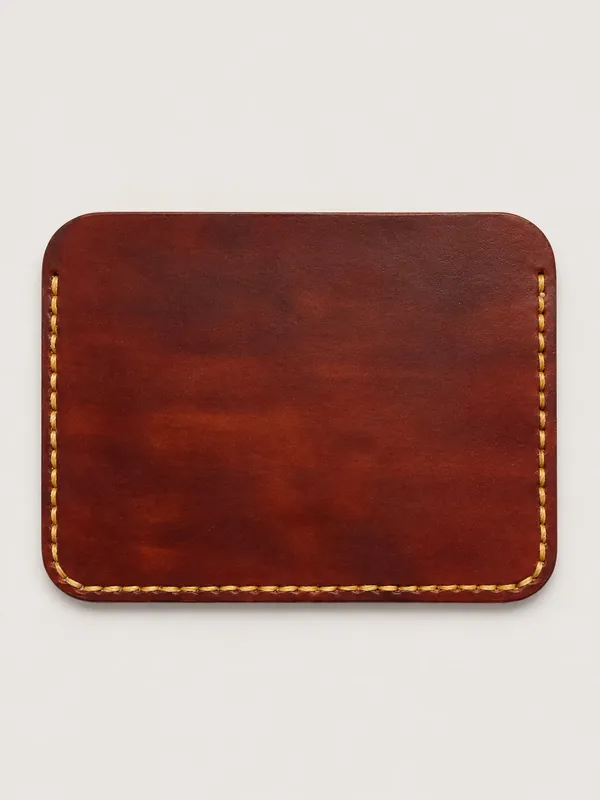
“Full-grain leather” is one of the most widely used terms in leather-goods product descriptions, and also one of the most misunderstood. If you have looked for a quality wallet or bag, you have very likely encountered this expression alongside others such as “corrected,” “split,” or “genuine,” without a clear explanation of what distinguishes each one. This article explains exactly what full-grain leather means—which layer of the hide it describes, what it promises, and what it does not—so you can interpret product descriptions with better judgment.
The first point to clarify: “full-grain” is not synonymous with “vegetable-tanned,” “handmade,” or any guaranteed level of finishing. It is a technical term describing a specific layer of animal hide and how it has been treated. Understanding its precise meaning prevents mistaken expectations in either direction.
What “grain” means in leather, and what makes it “full”
An animal's hide has several layers. The outermost—the one exposed to the outside world during the animal's life—is called the “grain” in leather-industry terminology. It is the layer with the highest fiber density, visible pores, and natural marks unique to each animal: small scars, variations in tone, and grain irregularities.
“Full-grain” leather means that this outer layer is preserved in its entirety: it has not been sanded, buffed, or corrected to remove imperfections. Natural marks, variations in pores, and the material's inherent irregularities remain. The leather has not been treated to appear more uniform than it is.
This contrasts with “corrected-grain” leather, in which the top layer is lightly sanded to remove defects and a finishing layer is applied to create a more homogeneous appearance. Corrected-grain leather has a more uniform feel and a more consistent appearance between pieces, but has lost some of the original grain's visual information.
Full-grain versus other leather types: what changes in practice
Understanding full-grain leather means considering it alongside the other main types:
Corrected-grain leather is, as described, full-grain leather whose outer surface has been sanded and finished. The result is visually more uniform, accepts dyes and finishes more predictably, and varies less between pieces. It is the most common leather type in medium- to high-volume production.
Split leather or split hide is the lower layer of the hide, separated from the grain layer. It does not have the same fiber density as the upper layer and is more porous. It is often used with a surface finish that imitates the appearance of grain leather. It usually has lower abrasion resistance and less stable behavior when exposed to moisture, although the result also depends on the finish applied.
Reconstituted leather or bonded leather is not a layer of hide: it is a composite material made from leather fibers mixed with resin and binders, pressed and coated to imitate the appearance of natural leather. Its behavior in use is very different from that of any type of natural leather.
Full-grain sits at the top of this technical hierarchy for a physical reason: it preserves the hide's densest, strongest layer, with its original fibers. However, this does not mean that any piece made from full-grain leather is automatically superior to every other piece: the chosen thickness, tanning process, applied finish, and quality of construction also determine the final result.
What this description promises and what it does not guarantee
When a product description says “full-grain leather,” it tells you that the layer used is the hide's original, unsanded outer layer. That has real implications:
Variations in tone, pores, and texture between two pieces of the same model are normal and expected: they are not manufacturing defects but the consequence of using uncorrected material. Two wallets from the same artisan will not be identical, and that is part of the material's nature.
The ability to develop a patina—that is, gradually acquire visual character through use—is characteristic of full-grain leather without thick finishes sealing the surface. Depending on the specific finish, the surface may absorb moisture and products more directly, making it especially important to follow the care instructions provided by the piece's artisan or manufacturer.
What “full-grain” does not guarantee: the tanning process used (which may be vegetable, chrome, or another method), the leather's origin, the level of craftsmanship in the piece, or any specific durability expressed in years. Two full-grain pieces from different tanneries and different manufacturing backgrounds can behave very differently.
What to ask when assessing a handmade accessory
When considering a wallet, bag, or card holder and wanting to understand exactly what material it contains, asking the artisan directly is more reliable than relying on the label alone.
Asking “What type of leather do you use for this model?” can give you information about the layer (full-grain, corrected-grain, split), the tanning process (vegetable, chrome, combination), the approximate thickness, and the type of finish applied. Not every artisan works with full-grain leather, and not everyone who does explicitly mentions it in the product description.
At Woodman Studio, Oleg works with vegetable-tanned leather that he dyes himself. For any question about the specific material used in a model from the shop, the most direct channel is the contact page or WhatsApp. The Handmade section shows part of the process.
Have questions about the material used in a particular model? Ask Woodman Studio directly: get in touch now.
Frequently asked questions
Is “cuero de plena flor” the same as “full-grain leather”?
Yes. “Full-grain” is the equivalent English term for the same description: leather that retains the hide's original outer layer without sanding. The two expressions describe the same thing and are often used interchangeably in product descriptions by brands selling internationally.
Is full-grain leather always vegetable-tanned?
No. These are two independent categories. Full-grain describes which layer of the hide is used and whether it has been sanded. Tanning describes the chemical process that transforms the hide into leather. Leather can be full-grain and chrome-tanned, or full-grain and vegetable-tanned. It is worth asking about both characteristics separately if both matter to you.
Is corrected-grain leather poorer quality than full-grain?
It depends on the purpose. Corrected-grain leather is more uniform in appearance, takes solid-color dyes better, and varies less between pieces. Full-grain leather retains more visual information about the original material and generally has a greater ability to develop a patina, but also more variation. There is no absolute hierarchy; there are different characteristics depending on the use and aesthetic you want.
How can I visually recognize full-grain leather in a product photograph?
Full-grain leather without thick finishes shows variations in pores and tone across the surface, with naturally irregular grain. If the surface in the photograph looks completely homogeneous and without variation—like an embossed or plastic texture—it is probably corrected-grain leather with an applied finish or a non-natural material. That said, the photograph may not show enough detail, and requesting additional images of the surface grain is entirely reasonable.
Does full-grain leather require more care?
It is usually more sensitive to moisture when untreated and may absorb stains more easily, precisely because the surface is not sealed with thick finishes. Specific care depends on the finish of the particular piece, so following the artisan's or manufacturer's instructions is the most reliable approach. As a safe general guideline, a soft, dry cloth for dusting is the starting point. For Woodman Studio models, the Care section provides information on maintaining vegetable-tanned leather.