
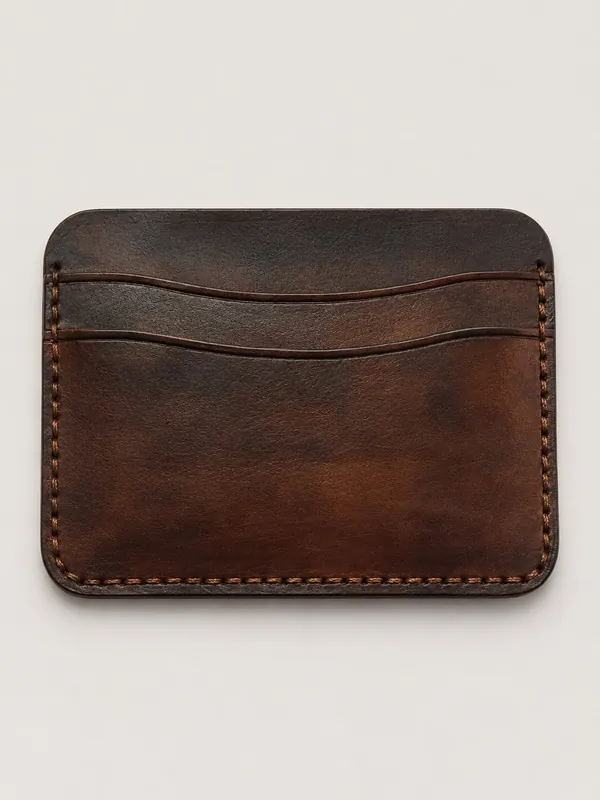
There is something that sets vegetable-tanned leather apart in leather goods: it never ages in quite the same way in any two pairs of hands. With time and use, it tends to develop what is known as patina—a gradual change in tone, a softening of texture, a visual depth resulting directly from the piece’s life with its owner.
It is not a sign of wear. It is exactly the opposite.
Before continuing, a clarification of terms: here we discuss vegetable-tanned leather—animal hide tanned with plant-derived tannins—not the alternative materials sometimes called “plant-based leather” or “vegan leather,” which have different compositions and behave differently.
What leather patina is
Patina is the visible change that occurs on the surface of leather over time, resulting from interaction with its surroundings and everyday use. This phenomenon is particularly characteristic of vegetable-tanned leather: the tannins used in tanning continue interacting with the material, and tones tend to deepen with time and daily use, as described by the Genuine Italian Vegetable-Tanned Leather Consortium, one of the sector’s reference sources.
The result is neither uniform nor precisely predictable: it depends on how you use the piece, the environment you live in, and whether you expose it to light or frequently keep it inside a bag. Two people buying the same model may have visually different pieces after a year of use—and that is not a material defect. It is its nature.
What factors create patina
Patina on vegetable-tanned leather develops through a combination of several everyday factors:
Natural light is one of the most visible agents. Vegetable-tanned leather tends to darken progressively with exposure to light, developing warmer, deeper tones than its original color. The ambient light encountered during normal use is enough for the process to advance gradually.
Contact with hands also contributes. The skin’s natural oils permeate the leather fibers, adding a soft sheen that emerges with regular use. The most frequently touched areas—the edge of a wallet, the flap of a card holder—are usually the first to show this change.
The environment and manner of use influence the speed and character of the process. Climate, ambient humidity and how the piece is stored—in a dark bag, in a trouser pocket, on a table—make subtle differences to the final result. That is why each piece’s patina is, in practice, impossible to replicate.
Maintenance also leaves its mark. Conditioners compatible with the piece’s finish—applied according to the artisan’s instructions—can contribute to a more even appearance. They do not create patina artificially; they support a process already taking place. If you are unsure what your piece can tolerate, ask before applying anything.
What to expect at each stage of use
During the first few weeks, the change is usually still subtle. Vegetable-tanned leather tends to start out lighter in tone and somewhat firm, and begins to give slightly with the warmth of the hands and regular use. Some people find this “breaking-in” stage especially interesting, because it is when the piece starts to adapt.
With continued regular use, the change in tone in the areas of greatest contact becomes more apparent. The difference between the outer face—more exposed—and the inside or folds starts to become visible. No two pieces are alike at this stage.
Over the months and years, the process continues to deepen the tone. Many people describe the result in well-cared-for pieces as richer than the original appearance: the tone settles, the overall look becomes more cohesive and the piece tells its own story of use. The exact pace varies according to the leather, finish and circumstances of each case.
Patina is not the same as damage
It is worth making this distinction because confusion is easy, especially if you are unfamiliar with the material. Patina is a gradual process that enriches leather’s appearance. Damage—deep scratches, untreated stains, cracks caused by drying out—is something else.
Patina appears in areas of regular use, with a gentle transition in tone. Marks from rough or neglectful use, by contrast, look irregular and do not follow the pattern of normal contact. Sensible care allows the former to develop naturally while preventing the latter. If you see changes you do not know how to interpret, it is best to ask for an assessment before applying treatments.
Why it is part of the appeal of a handmade piece
The fact that vegetable-tanned leather develops patina is a consequence of the chosen tanning process. Plant tannins—which are also chemical compounds, of plant origin—produce a material that responds visibly to time and use. Other tanning processes, such as chrome tanning, produce leathers that age differently; these are not better or worse materials, but materials that behave differently.
At Woodman Studio, Oleg works vegetable-tanned leather by hand, and his pieces are not intended to look identical on the first day and years later: they are intended to become increasingly personal to whoever uses them. You can see how the leather is worked in the Handmade section.
If you would like to see the available pieces and get an idea of how the leather is worked before it reaches your hands, visit the Woodman Studio shop. For any questions about materials or what to expect from a particular piece, you can write on WhatsApp.
Frequently asked questions
Do all vegetable-tanned leather pieces develop patina? The process is characteristic of this type of tanning and occurs naturally with use. Its speed and outcome depend on the type of finish, regular use and maintenance. It is not an identical process in every piece or under every condition.
Can patina be accelerated artificially? Some people apply oils or expose leather to sunlight to speed up the process. This is not recommended: it can cause uneven stains or unwanted changes to the finish, and the result depends on the specific leather and finish. The most even patina develops through normal use and care appropriate to the piece.
Does chrome-tanned leather also develop patina? Chrome-tanned leather ages differently, generally with less visible change in tone than vegetable-tanned leather. This does not mean it is an inferior material: each tanning process produces different behavior over time, suited to different uses.
Can patina disappear with cleaning? Patina is integrated into the material and does not disappear with routine gentle cleaning, such as with a dry cloth. An aggressive product could alter the tone or finish; that is why it is best to stick to gentle cleaning and seek advice before using any product.
What if I do not like how my piece is changing? If you notice uneven changes or stains that do not correspond to normal use, it may be a sign that the leather needs attention. Before applying treatments yourself, ask the artisan or a leather specialist for an assessment: they can tell you whether it is normal development or something that should be treated.