
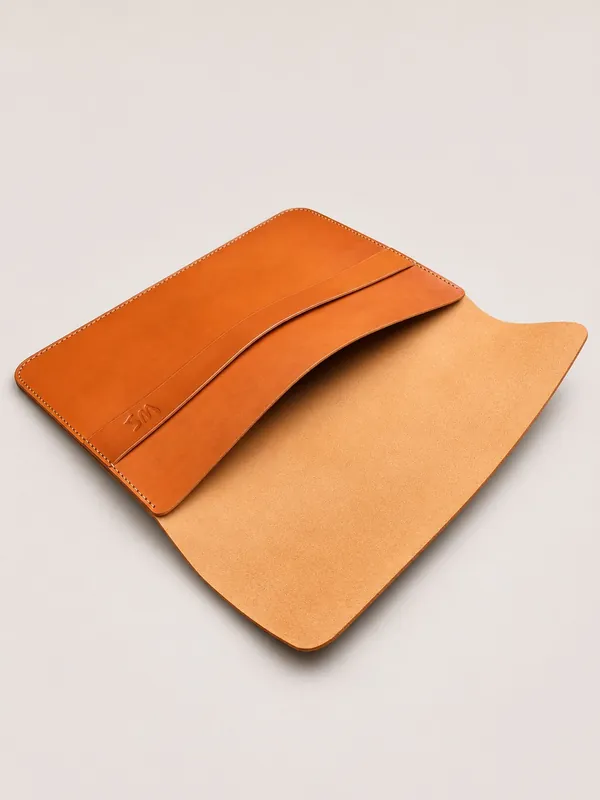
Barcelona is a city where artisan leatherworking has a real presence. It is not just history or heritage: there are active artisans, workshops producing their own work, and local and international demand sustaining this craft. If you are looking for artisan leather goods in Barcelona—whether for yourself or as a gift—this guide explains exactly what artisan leatherworking is, how to distinguish it from what it is not, and what questions are worth asking before buying a piece.
What artisan leatherworking is and what it is not
The Spanish word marroquinería describes the craft of working hide to make objects: bags, wallets, card holders, belts, cases and other accessories. The term originates from Moroccan leather—hide worked in Morocco using traditional tanning techniques—although today it is used more broadly to refer to leatherworking in general.
What distinguishes artisan leatherworking from industrial production is not a certification or a label: it is the way of working. In artisan production, the artisan designs, cuts, stitches and shapes the piece with their hands and a set of precision tools. The result is not identical in every unit: there are minor variations that are part of the process, not defects. Each piece is the result of specific decisions made by a specific person.
In industrial production, efficiency at scale matters more than that individuality. There is good industrial production and poor craftsmanship, as in any field. What changes is what you can expect from the object: artisan production gives you access to the process and the judgment of whoever made it; industrial production gives you a standardized result.
Barcelona and leather: a living context
The Gothic Quarter, Born and the neighborhoods around Barcelona’s historic center maintain a visible presence of leather artisans. The streets of these areas have traditionally housed precision crafts: shoemakers, bookbinders, saddlers, leatherworkers. There are long-established businesses and more recent ones taking a different approach, combining traditional techniques with contemporary design.
This concentration is no accident. It relates to the tradition of medieval guilds, proximity to historic raw-material markets, and the identity of the historic center as a place where neighborhood commerce and craft have survived the pressure of mass tourism and speculation. Not all artisans producing significant work have a physical workshop in the Gothic Quarter, but the city as a whole—its architecture, its spaces and its visual heritage—remains a source of reference for many of them.
Barcelona’s Gothic architecture, in particular, serves as a visual vocabulary for artisans working in design. The arches, tracery and rose windows of the Cathedral, of Santa María del Mar, of the streets of Born: these are forms that recur in leather designs when an artisan wants to connect their work with the place. This is what happens in the work of Oleg Naumenko of Woodman Studio, whose new design line—still in development—takes the city’s architecture as a direct source of inspiration.
What distinguishes an artisan from a distributor
When you look for artisan leather goods, not everything presented as handmade really is. There are distributors selling imported leather goods with artisan labels, souvenir shops mixing handmade pieces with industrial products, and brands using the language of craftsmanship without the process to justify it. Some indicators help distinguish them:
The artisan can explain the process. If you ask how a piece was made and the answer is vague or limited to “it is handmade,” something does not add up. A genuine artisan can describe which tools they used, how long the piece took, what type of leather they chose and why, and how they handled the stitching.
The artisan designs their own pieces. Designer-led artisan leatherworking does not reproduce models from a generic catalog. The artisan has developed their own shapes, solved their own design problems and makes decisions recognizably their own. This does not mean the pieces are extravagant; it can be minimalism taken to its cleanest expression.
The piece has irregularities that are part of the work. A handmade piece is not perfectly homogeneous. The stitching may have slightly varying tension, the dye may show tonal variations, the edge may show the work of the hand. These irregularities are not defects: they are the signature of the manual process. If a piece is perfectly uniform in every respect, it is probably not handmade.
How to assess a piece before buying
Beyond getting to know the artisan, there are specific aspects to look at when assessing an artisan leather piece:
The leather and its process. Asking what type of leather is used and how it was tanned provides relevant information. Vegetable-tanned leather—animal hide tanned with plant-derived tannins, a different process from that used for so-called “vegan leathers,” synthetic- or plant-based alternative materials that are not hide—is one of the most valued materials in artisan leatherworking for its density, its response to handwork and the patina it usually develops with use.
The stitching. Stitching is the area under the greatest stress in any leather accessory. Well-executed stitching—with appropriately thick thread, even tension and properly closed stitches—is a sign of careful work. Stitching with thread too thin for the material, irregular stitches or inconsistent tension is a warning sign, regardless of what the label says.
The edges and finishes. The edges of a leather piece are areas of intense wear. A well-finished edge—burnished, painted or treated using the appropriate technique for the material—withstands use; an untreated one, or one with a finish that comes off easily, does not.
The coherence of the whole. A good artisan piece has coherence between design, material and construction. There are no ornaments serving no function, no parts that seem added without reason. Form serves use, and material serves form.
Why get to know the maker of what you buy
Designer-led artisan leatherworking has a dimension beyond the object’s quality: the possibility of getting to know whoever made it. This is not sentimentality; it has practical consequences. When you know the artisan, you can ask about your piece’s specific material, the maintenance they recommend for that particular finish, and why they made certain design decisions. That information is not available in any generic manual.
At Woodman Studio, Oleg Naumenko designs his models, dyes the vegetable-tanned leather and does practically all the work by hand. He is also a Ukrainian Paralympic fencer, with a personal story that informs his work without fully explaining it. His current visual inspiration comes from the Gothic architecture of Barcelona and Paris, a connection between architecture and leather that is still developing and gives his pieces their own design language.
You can browse Woodman Studio’s catalog in the shop, get to know Oleg in the section about him, and understand his process in Handmade. For any questions before buying, write to us on WhatsApp or visit the contact page.
Frequently asked questions
What is artisan leatherworking? Artisan leatherworking is the craft of making leather objects—bags, wallets, card holders, belts and other accessories—by hand, using precision tools. Unlike industrial production, the artisan directly designs, cuts, stitches and shapes each piece, making decisions reflected in the final result.
What characterizes leather artisans in Barcelona? Barcelona has a living tradition of artisan leatherworking, especially around the Gothic Quarter and El Born. Artisans producing their own work in this city generally design their own pieces, work with individually chosen materials and can explain the manufacturing process in detail. Not all have a physical workshop open to the public, but their work is available directly or through their own channels.
How do I know whether a leather piece is genuinely handmade? The most reliable indicators are: that the artisan can describe the process accurately, that the piece has irregularities typical of handwork, that the material is consistent with its stated use, and that the design is the artisan’s own rather than a generic catalog model. Minor irregularities are part of the artisan process, not defects.
What questions should I ask before buying a piece? Some useful ones: What type of leather is it and how was it tanned? How long does it take to make this piece? What maintenance do you recommend for this finish? Can you explain how the stitching is handled? A genuine artisan can answer all of them accurately.
Where can I find Woodman Studio’s artisan leather goods? In the Woodman Studio shop, you can browse the catalog of current pieces: bags, wallets and card holders in vegetable-tanned leather worked by hand by Oleg Naumenko. For questions, you can write on WhatsApp or through the contact page.