
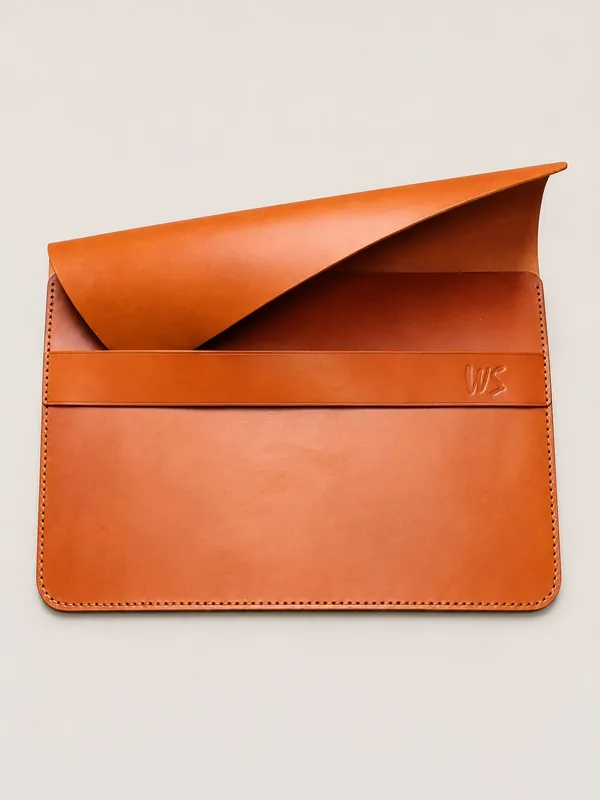
Natural leather is a strong material, but not an invulnerable one. Much of the damage that appears on leather wallets, card holders and bags is not caused by heavy use itself: it comes from care mistakes that accumulate over time and, in many cases, are entirely avoidable. Some are intuitive; others surprise even those already experienced with this material.
Below you will find the most frequent mistakes, why they happen and what to do instead.
Using too much water when cleaning
Natural leather absorbs water, and when it becomes soaked in an uncontrolled way, difficult-to-reverse stains and distortion can appear, along with progressive weakening of the fibers if the process is repeated. Its exact sensitivity depends on the type of leather and each piece’s finish, but excess water benefits none of them.
The safest cleaning is dry, with a soft cloth. Never immerse a piece in water, do not hold it under a tap and avoid applying water directly to the surface. If the leather gets wet accidentally, absorb the excess as soon as possible with a dry cloth, without rubbing, and let it dry at room temperature.
Applying household cleaning products
Glass cleaner, bleach, shower gel, alcohol, conventional stain remover... None of these products is intended for leather, and some of their ingredients can irreversibly alter the finish: discoloration, loss of flexibility, staining or accelerated drying out.
The temptation to use whatever is at hand is understandable, but the result rarely justifies the risk. The safest option is a dry cloth. If you need something more, not all products “for leather” are suitable for every leather or finish: before using any, check compatibility with your piece by consulting the instructions of the artisan who made it. And remember that testing a product in an inconspicuous area helps detect obvious reactions, but does not guarantee compatibility.
Drying leather with direct heat
When leather gets wet—from rain, cleaning or an accident—the usual reaction is to try to dry it quickly. The problem is that concentrated heat does exactly the opposite of what leather needs: instead of drying it gently, it hardens the fibers and can cause cracks, stiffness or changes to the finish that are difficult to correct.
The usual culprits are hair dryers, radiators, intense direct sunlight and rooms with very dry heating. The solution is always the same: dry at room temperature, in a ventilated place and without rushing. If the leather takes a while to dry, that is not a problem: the natural process does not damage it.
Storing it somewhere damp or unventilated
Storage matters more than it might seem. Keeping a leather wallet or bag in a space with high humidity—a drawer in a damp part of the house, a sealed plastic bag, a car interior with condensation—encourages mold and stains that are difficult to remove.
Leather needs to breathe. It is best stored somewhere dry with moderate air circulation and, if possible, inside a cloth or muslin bag—never plastic—when not used for a long period. Plastic covers trap moisture and create the ideal environment for mold to thrive.
Regularly overloading it
This mistake has nothing to do with cleaning, but with use. Forcing a wallet or card holder beyond its normal capacity—accumulating coins, receipts, extra cards, keys—creates continuous strain on stitching, folds and closures. Over time, that strain causes them to give way.
It is not about treating the piece with extreme delicacy, but about not systematically forcing it. A well-constructed leather piece is designed for active use; it is not designed to accommodate the excess contents we would otherwise carry in another one.
Neglecting the material for too long
Natural leather can become progressively stiffer, more fragile and more prone to cracking if neglected for a long time, especially at folds and edges. What matters is observing the piece: an appearance duller than usual, stiffness when bending or dry edges are signs that it needs attention.
What to do about these signs depends on your piece’s specific leather and finish. Do not routinely apply generic balms or conditioners, or follow fixed schedules: consult the artisan’s instructions about which product your piece can tolerate and how to apply it. It is better to act thoughtfully at the first signs than to try restoring leather that is already visibly dried out, which takes much more effort—and sometimes professional help.
Exposing it to sunlight for prolonged periods
Light influences the evolving tone of vegetable-tanned leather, as explained in discussions of patina. But there is an important difference between the normal exposure of everyday use and prolonged exposure to direct sunlight—for example, leaving a wallet on a car dashboard or a brightly lit shelf. The latter can cause uneven discoloration, drying out and loss of finish in the exposed area.
There is no need to protect the piece obsessively from light; normal use does not create this problem. But avoiding intense, prolonged sun exposure is a simple care measure that preserves an even tone and finish.
| Mistake | Consequence | What to do instead |
|---|---|---|
| Excess water when cleaning | Stains, distortion | Dry cleaning; a barely damp cloth only if the piece allows it |
| Household products | Discoloration, drying out | Dry cloth; products only if compatible with the finish |
| Direct heat for drying | Cracks, stiffness | Dry at room temperature |
| Storage in a damp space | Mold, stains | Dry place, cloth bag, ventilation |
| Regular overloading | Damaged stitching and folds | Respect the piece’s capacity |
| Prolonged neglect | Stiffness, cracks | Observe the piece and act according to the artisan’s instructions |
| Intense sun exposure | Uneven discoloration | Avoid prolonged direct sunlight |
For a complete care and cleaning procedure, visit the Woodman Studio care section. If you have questions about a specific piece or damage that has already appeared, you can ask directly on WhatsApp.
Frequently asked questions
Is vegetable-tanned leather more sensitive than other types of leather? It depends on the specific leather and finish: you cannot generalize that all vegetable-tanned leather is more porous or sensitive than all chrome-tanned leather. Many vegetable-tanned leathers benefit from attentive care regarding water and harsh products, and in return evolve very expressively with use. What matters most is knowing your piece’s characteristics.
What should I do if cracks have already appeared in the leather? Do not attempt intensive treatments yourself: the appropriate approach varies according to the depth of the cracks and the type of finish. Consult the artisan or a leather restoration specialist, who can assess whether the piece can be restored and with what treatment.
Can mold on leather be treated? In its early stages it may be treatable, but the appropriate intervention depends on the piece’s condition and finish. The most sensible approach is to air the piece in a dry environment and ask for an assessment before applying products. In advanced stages there may be permanent damage. The best strategy is prevention through appropriate storage.
Does rainwater damage leather? Occasional exposure to rain does not usually cause permanent damage if handled properly: absorb the excess with a dry cloth without rubbing and let it dry at room temperature, without direct heat. Problems arise with repeated exposure without subsequent care, or when the leather was already very dry. If marks remain that worry you, ask for an assessment before applying treatments.
How often should I check the leather’s condition? There is no need for a formal periodic inspection: observing it as you use it is enough. Signs that it needs attention include an appearance duller than usual, stiffness when bending, drier edges or the first visible cracks in frequently used areas.