
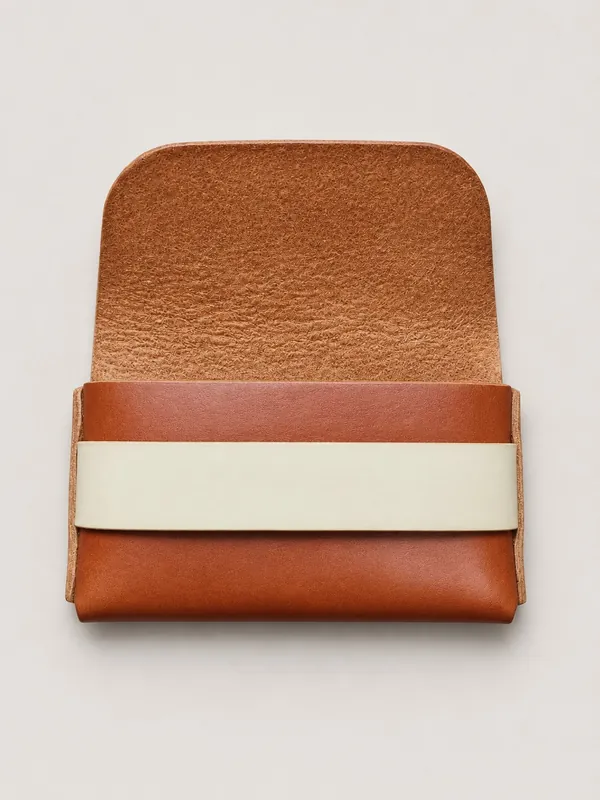
When someone compares the price of a handmade leather wallet with a more affordable option, the question that almost always arises is the same: how long will it last? It is a reasonable question. The problem is that it has no fixed answer, because a leather piece’s lifespan is not an inherent property of the object: it is the result of several combined factors, some depending on the maker and others on the person using it.
Understanding what really determines durability helps you make a more informed purchase—and also get the most from the piece you already own.
The type of leather and how it was tanned
Not all leather is the same, nor does it age in the same way. The tanning process—the treatment that transforms hide into leather—directly influences the final material’s properties: its strength, its behavior when exposed to moisture, its response to maintenance and the way it evolves with prolonged use.
Vegetable-tanned leather uses plant-derived tannins—which are also chemical compounds, extracted from bark and other plant parts—and tends to produce firm materials with body and the ability to develop an expressive patina over time. These characteristics are associated with good durability when the piece receives care appropriate to its finish.
Chrome-tanned leather, meanwhile, tends to produce materials that are softer and more uniform from the outset, with a different appearance as they age. It is not necessarily lower in quality or less durable: each process has different properties, suited to different uses. What matters is knowing the material your piece is made from so that you know how to treat it.
Construction: what is not always visible
The material is the starting point, but construction determines how it holds up in real use. Two aspects make a particular difference:
Stitching. These are the areas under greatest strain in any leather accessory. Stitching made with strong thread, at the correct tension and in a thickness appropriate to the material will withstand normal use without giving way. Stitching with unsuitable thread, poor tension or poorly secured ends fails sooner, whatever the production method. In hand-stitched pieces, the artisan directly controls every stitch; it is a different way of managing this variable.
Edges and folds. The edges of a wallet or a bag’s flaps are areas of intense wear. A well-finished edge—burnished, painted or sealed using the technique appropriate to the leather type—resists continuous friction better than an untreated edge or one with a superficial finish that peels away within a few weeks.
How it is used every day
This is the most overlooked factor, yet one of the most influential. A well-made leather piece can deteriorate prematurely if used without regard for its characteristics; and a piece made with more modest materials can last quite a while if used thoughtfully.
What most affects durability in everyday use:
- Systematically overloading the piece. Forcing in more contents than the piece is designed to hold creates continuous strain on stitching and closures.
- The type of regular contact. A wallet carried in a back trouser pocket experiences more pressure than one in a bag. A bag always placed on hard surfaces wears sooner on the bottom.
- Exposure to extreme conditions: constant humidity, intense heat or direct sunlight for long periods are factors that accelerate deterioration.
None of this means treating the piece with extreme delicacy. It means that normal everyday use—without abuse—preserves the piece much better than neglectful use.
Maintenance appropriate to the piece
Natural leather benefits from minimal but consistent attention. The foundation is simple and risk-free: cleaning with a soft, dry cloth when needed, and observing the material’s condition. If the leather starts showing signs of drying out—dullness, stiffness, dry edges—the next step is not to apply just any product: it is to use only treatments compatible with your piece’s specific leather and finish, following the instructions of the artisan who made it. There are no universal schedules or formulas suitable for every leather.
The difference between a piece that stays in good condition and one that deteriorates prematurely very often lies in this ongoing attention: noticing the signs in time and acting thoughtfully, rather than allowing the material to reach a condition that is difficult to reverse.
Storage when not in use
This factor matters especially for pieces put away for long periods—an entire season, for example—or when alternating between several pieces. Leather needs storage conditions that allow it to breathe: a dry environment with moderate ventilation and no prolonged compression.
Storing it crushed beneath other things, in a sealed plastic bag or in a damp space can cause pressure marks that are difficult to remove, mold or deterioration of the finish that would not otherwise occur. A cloth bag and a suitable place prevent most of these problems.
The investment perspective
When these five factors are considered, the comparison between a handmade piece and a cheaper one looks different. A well-constructed piece, bought at a higher price but maintained with basic, appropriate care, may accompany you for much longer than several lower-priced pieces bought one after another.
This is not a promise of specific performance—actual lifespan will always depend on the factors described—but a way of thinking about value. A handmade wallet is not expensive if it lasts; it is expensive if treated like a disposable one.
If you would like to see the pieces available at Woodman Studio and learn more about how Oleg works leather, visit the shop or the Handmade section. For any questions about materials or the construction of a particular model, you can write on WhatsApp.
Frequently asked questions
How many years does a handmade leather wallet last? There is no single figure because actual lifespan depends on the leather type, construction, use and maintenance. The specific figures sometimes quoted online refer to ideal conditions and particular materials; the most honest answer is that a well-constructed, well-cared-for piece can provide extended use, without committing to a fixed number of years.
Is hand stitching more durable than industrial stitching? Hand stitching allows the tension of every stitch to be controlled individually, which generally results in even stitching well suited to the leather’s thickness. With techniques such as saddle stitching, if a thread is damaged at one point, the rest of the stitching tends to stay in place. This is a real technical difference, although not the only factor determining a piece’s durability: well-executed industrial stitching can also be very durable.
Is it worth repairing a handmade leather wallet when something gives way? In many cases yes, especially if the leather and construction are high quality. Repairing stitching or an edge is feasible and, in a well-made piece, the result can be practically imperceptible. Repairability is part of the value of handmade accessories. For specific damage, it is best to ask for an assessment before deciding.
How can I tell whether a leather piece is well constructed before buying it? Finished, polished edges, even stitching without irregular stitches, the leather’s behavior when bent slightly—giving without creaking or splitting—and consistent material thickness are useful indicators. When buying online, detailed photographs and information about the process are the main reference points; if you have doubts, ask directly about the material and construction of the model that interests you.
What damages a wallet more: use or lack of maintenance? Depending on the case, both can contribute. But deterioration from prolonged neglect is usually more silent and cumulative than that from normal active use. A piece that is used a great deal but cared for well generally holds up better than one barely used but stored for years in poor conditions without any attention.