
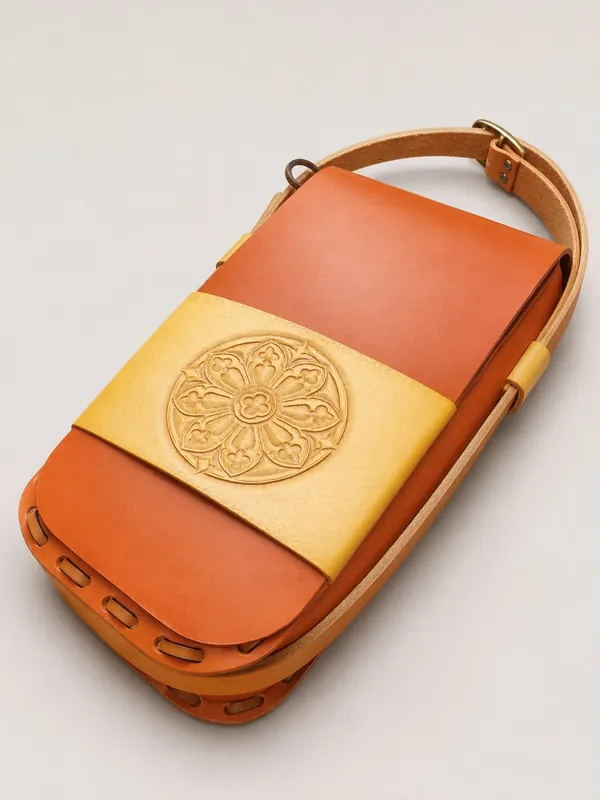
Some cities act as permanent sketchbooks for anyone who works with form. Barcelona is one of them, and not only because of its Modernist buildings: the city’s medieval heart—the Gothic Quarter, El Born, the streets surrounding Santa María del Mar—contains a visual vocabulary of extraordinary coherence. It is in this part of the city that Oleg Naumenko, leather artisan and designer at Woodman Studio, finds many of the references shaping his new direction. This is the story of how 14th-century stone becomes a starting point for designing leather in the 21st century.
A city built in stone and light
Barcelona’s Gothic architecture is not monolithic. The Cathedral of Santa Creu i Santa Eulàlia, with its inner cloister and ribbed vaulting, speaks a different language from Santa María del Mar, built between 1329 and 1383—just over fifty years—with the active participation of the Ribera neighborhood, and considered one of the purest examples of Catalan Gothic (Historia National Geographic). The two are just a few minutes’ walk apart.
What unites these buildings—and the narrow streets of the Gothic Quarter and Born surrounding them—is a very specific formal language: the pointed arch drawing the eye upward, the tracery turning the window opening into stone lace, the rose window filtering and breaking up the light. These are not ornaments added to a functional building. They are the function itself: the way medieval structures solved the problem of allowing a stone wall to admit light without collapsing. Form emerges from the technical problem, and the result is beautiful precisely because it is necessary. For someone who works with materials and by hand, this logic is genuinely relevant.
Paris takes this vocabulary even further. The stained-glass windows of Sainte-Chapelle cover practically the entire surface of its walls; the building is, essentially, a stone frame for light. Notre-Dame, with its towered façade and central rose window, is the most recognizable example of French Gothic taken to its fullest formal expression. Oleg photographs these spaces and details himself as a source of visual reference.
From space to object: what makes Gothic architecture interesting
When Oleg works with Gothic architectural references, he is not looking for a decorative motif to add to a surface. He is studying how a form built on the scale of a city can be reduced, compressed and remain recognizable on the scale of an object. This is a design problem with a long tradition: the medieval applied arts—ivory, metalwork, textiles, manuscript illumination—constantly reproduced architectural motifs on a small scale, and the result was not a copy but a translation.
What makes this transfer feasible in leather is that the material, particularly the vegetable-tanned leather Woodman Studio works with, responds well to relief work: it is generally a firm, dense type of leather, which helps an engraved motif retain its definition with use. Its exact behavior depends on the particular leather and the finish of each piece, but the material generally has the substance needed to support this kind of design.
Tracery—that network of fine ribs structuring rose windows and Gothic windows—is one of the recurring references in the development of this line. Not as a literal copy, but as a principle: the idea that an element can be structural and decorative at the same time, that a useful form can also be a beautiful one. This is the line of thought connecting Gothic design with artisan leatherwork.
A line in development, not an available collection
The proposed pieces with Gothic and historical motifs that Oleg is developing are not yet available. This is a work in progress, for specific reasons: translating architectural references into functional objects—wallets, bags, card holders—requires answering design questions with no obvious answers. Where does the motif go on the piece? At what scale? How does it relate to the shape of the object supporting it? What remains when the leather ages and the patina changes the light and shadow values of the relief?
These questions cannot be answered on paper; they can only be resolved by making things. That is why the process is slow, and why there is no launch date to announce yet. What can be shared at this stage is the direction and the source: the Gothic architecture of Barcelona and Paris, photographed personally by Oleg, interpreted through the language of handmade artisan leatherwork.
Why the story behind a design matters
A leather accessory can be functional and well constructed without having a design story to tell. But when that story exists, when you can trace it from a building on a particular street to the piece you carry in your pocket, your relationship with the object changes. Not because this makes the object more useful or durable, but because understanding why something has the shape it does helps you appreciate it differently.
This is the underlying argument for working with artisans who design their own pieces rather than reproducing established models. An artisan who designs from a specific source makes particular decisions, can explain them, and connects the object to a place and a perspective. That is not something you can buy in mass production, however much it costs.
If you are interested in following the evolution of this line and Woodman Studio’s current work, you can browse the catalog in the shop, discover Oleg’s process in the Handmade section or visit the page about him. For any questions about current or upcoming designs, write to us on WhatsApp or through the contact page.
Frequently asked questions
What is Woodman Studio’s new Gothic line? It is a line of leather pieces featuring motifs inspired by the Gothic architecture of Barcelona and Paris that Oleg Naumenko is currently developing. It is not yet available for sale. Once the pieces are finished, they will be announced through Woodman Studio’s channels.
When will the collection with Gothic motifs be available? There is no confirmed launch date. The process of translating architectural motifs into functional leather objects requires design decisions that only become clear by making the actual pieces. Development is ongoing.
Which monuments or spaces does Oleg draw inspiration from? Mainly Barcelona’s Gothic Quarter, the Cathedral of Santa Creu i Santa Eulàlia, Santa María del Mar and the Born neighborhood. Also Gothic monuments in Paris, photographed personally by Oleg as visual working references.
How are architectural motifs transferred to leather? Through engraving techniques on vegetable-tanned leather, a generally firm, dense material that helps preserve the definition of the detail; the specific result depends on the leather and finish of each piece. The motifs are adapted to the scale and function of each object, rather than reproduced literally from the architecture.
Where can I see Woodman Studio’s current work while this line is being developed? You can see the current catalog of pieces in the Woodman Studio shop. The Handmade section explains Oleg’s working process. You can also follow his TikTok and Instagram accounts to see work in progress.