
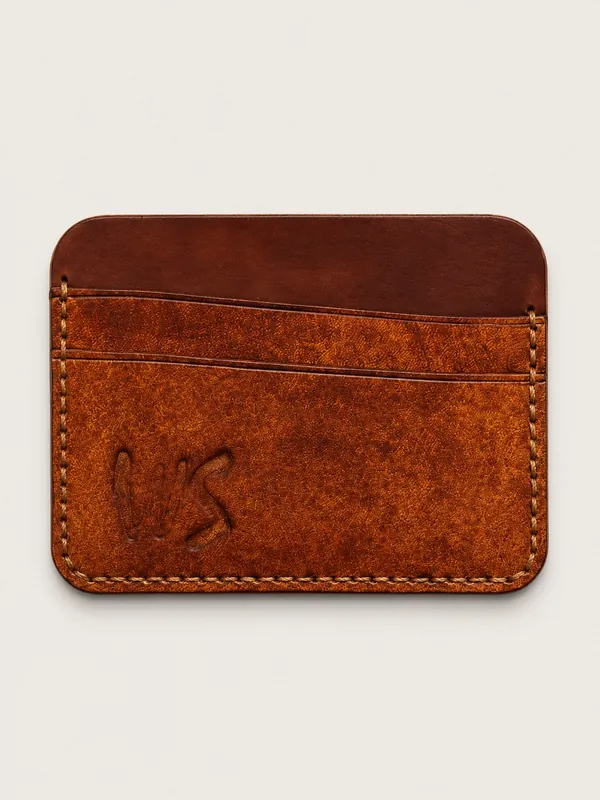
Choosing between a natural leather wallet and one made from synthetic material is not just a financial decision. There are real differences in how each material behaves in daily use, what care it needs, and how it ages over time. Some of these differences favor natural leather; others, depending on the context, may favor synthetic materials. This comparison explains what really changes between the two without claiming that one is always the best option.
Before we begin, a clarification to avoid common confusion: “vegetable-tanned leather” is animal hide tanned with plant extracts. It is not a vegan or synthetic material. Synthetic materials are a completely different category—faux leather, PU, PVC, technical textiles—and have their own characteristics that deserve an honest explanation.
How they behave in daily use
Natural leather is an organic material that responds to its surroundings. It quickly absorbs body heat and feels warm to the touch after some use. It gradually adapts to the shape of its contents and its user's habits. Over time and with continued use, it accumulates small marks and a change in tone known in vegetable-tanned leather as patina: the piece naturally becomes personalized. Not everyone values this equally; for some it is the main attraction, while for others it is simply aging.
Medium-quality synthetic materials—faux leather and PU are the most common in accessories—behave more consistently in the short term. They do not absorb heat in the same way, retain a more consistent appearance during the first few years, and do not develop a patina: what you see on day one is what you will have for much of the material's useful life. This may be an advantage if you want visual consistency; it is a limitation if you want the piece to evolve.
Natural leather, especially vegetable-tanned leather without highly occlusive finishes, can become stained by moisture if untreated. Synthetic materials are generally more resistant to surface stains and easier to clean with a damp cloth.
What each material needs to stay in good condition
Care is one of the factors that most distinguishes the two materials, and also where people unfamiliar with them most often go wrong.
For natural leather, the safest basic care is simple: a soft, dry cloth to remove dust, and avoiding prolonged exposure to sunlight and direct heat sources. The use of moisture, conditioners, or cleaning products depends on the leather type and each piece's specific finish: not all products are compatible with all finishes, so follow the artisan's or manufacturer's instructions before applying anything. Testing on an inconspicuous area can help detect immediate reactions, but does not guarantee the product's compatibility with the finish. For a significant stain or damage, the most prudent course is to ask the artisan for an assessment before attempting any treatment yourself.
Synthetic materials are more forgiving to maintain. Faux leather and PU do not need conditioning because they have no natural fibers that can dry out, and most surface stains can be cleaned with a slightly damp cloth. However, products designed for natural leather may damage the finishing layer of some synthetics. The general rule is to use only what the manufacturer recommends for the specific material.
For Woodman Studio models, which use vegetable-tanned leather, the Care section provides specific maintenance information. Caring for vegetable-tanned leather has its own particular requirements compared with other types of natural leather.
How each material ages: visible wear
For many buyers, how a material ages is the deciding factor between the two.
Well-maintained natural leather ages in its own distinctive way. Corners become rounded, the tone evolves, and the grain settles. Marks from use accumulate as the piece's history, and in well-constructed vegetable-tanned leather this process can last many years. The piece does not remain “new” after years of use, but neither does it fall apart: it evolves.
When natural leather does not receive the care it needs or is repeatedly exposed to adverse conditions—moisture left undried, direct heat, harsh chemicals—it may crack in ways that are not easily repaired. In this respect, natural leather demands more attention than synthetic materials.
Medium-quality synthetic materials behave differently over time. During the first few years they may retain their appearance very well, but beyond a certain point deterioration is more abrupt: the polyurethane layer begins to crack, flake, or peel, and that process is irreversible. How quickly this happens depends on material quality, use, and environment, but it is a structural limitation of the most common synthetic materials: generally, they do not evolve; they tend to deteriorate.
There are high-performance synthetic materials—some used in technical applications or high-end fashion—that behave more durably and degrade in a way more similar to natural leather. It is not fair to generalize about the entire synthetic category based on the behavior of inexpensive faux leather.
When each option makes sense
The choice between natural leather and synthetic material depends on what you value and how you intend to use the piece.
Natural leather makes sense if you want the piece to evolve with use, are willing to pay attention to it and care for it according to the artisan's or manufacturer's instructions, and want something intended to accompany you for a long time with proper treatment. It also makes sense if the manufacturing process and material's origin are part of what you value in an accessory.
Synthetic materials make sense if you want consistency of appearance in the short term, greater moisture resistance without special care, or prefer not to use animal-derived materials. The best synthetics on the market perform reasonably well for several years before beginning to deteriorate.
What makes little sense is buying a low-quality synthetic accessory expecting it to behave like natural leather, or buying natural leather without being willing to give it the care it needs.
Woodman Studio's wallet, card holder, and bag models are made from hand-worked vegetable-tanned leather. You can see them in the shop, and if you have questions about whether a specific model fits your use or material preference, the most direct channel is WhatsApp or the contact page.
Unsure whether vegetable-tanned leather fits your daily life? Write to us: get in touch now.
Frequently asked questions
Is vegetable-tanned leather the same as vegan leather?
No. Vegetable-tanned leather is animal hide tanned with plant extracts instead of chromium salts. The term “vegetable-tanned” describes the tanning process, not the material's origin. Vegan leather, by contrast, refers to materials of non-animal origin—polyurethane, technical fabrics, plant-based materials such as cork or cactus—which belong to a completely different category.
How long does a natural leather wallet last compared with a faux leather one?
It depends on material quality and care. With suitable maintenance, a well-made natural leather piece can last quite a few years. Medium-quality faux leather usually retains a good appearance for the first few years, but the polyurethane layer tends to crack or flake over time in ways that are not easily repaired. Absolute figures are difficult to give because use and care vary so much, but the difference in how they age is real.
Can I apply the same care products to natural leather and synthetic materials?
No. Products designed for natural leather—creams, oils, waxes—may damage the finishing layer of some synthetic materials. Faux leather and PU do not need conditioning, since they have no natural fibers that can dry out. Using the wrong products may accelerate deterioration rather than prevent it.
Is natural leather better than synthetic leather in absolute terms?
There is no absolute answer. Natural leather has properties that common synthetics cannot fully replicate—how it evolves, its breathability, its ability to develop a patina—but it also requires more care and can deteriorate if not maintained. High-end synthetic materials have advanced considerably and have their own advantages. The choice depends on what you value and what you need the piece for.
How does moisture affect natural leather?
Natural leather may stain or lose its shape if it gets wet and is not dried correctly, and repeated moisture can degrade its fibers. If a piece gets wet, letting it dry slowly at room temperature and avoiding direct heat—such as a radiator—is one of the few guidelines that applies to most natural leathers. Any subsequent treatment depends on the specific finish, so consult the artisan or manufacturer; for a significant stain or damage, ask for an assessment before applying anything.