
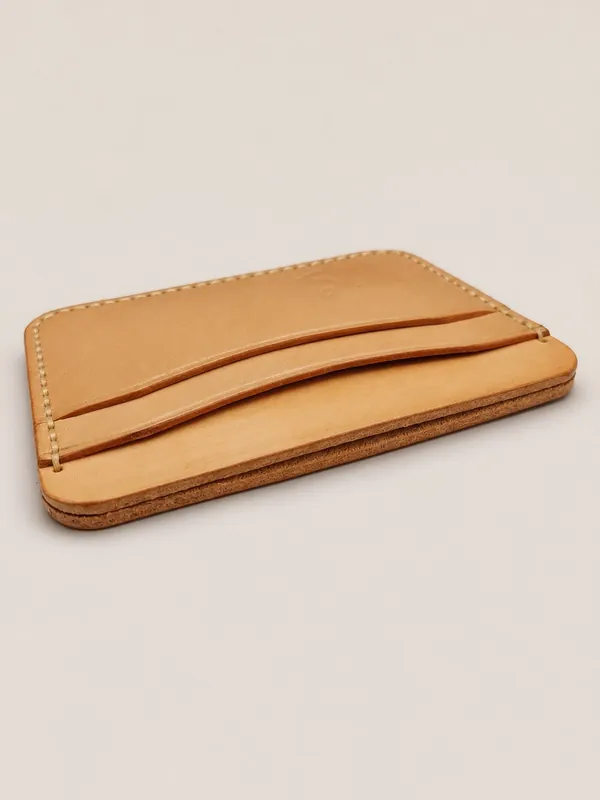
When Oleg describes the material he works with at Woodman Studio as “vegetable-tanned leather”, the most frequently asked question is: does that mean it is vegan leather? The answer is no. And it is worth explaining exactly why, because the confusion is very common and leads to misunderstandings that affect how a piece is understood and valued.
Vegetable-tanned leather and vegan leather are two completely different things. They share the word “vegetal” in their Spanish names—or in how they are commonly described—but refer to different realities: one is a way of processing animal leather; the other is a material specifically designed not to use animal hides.
What vegetable tanning is
Tanning is the process by which a raw animal hide becomes leather. Without this process, the hide would deteriorate quickly. Tanning stabilises the hide's fibres, gives it strength and allows it to last for years.
There are different ways to tan leather. The most widespread in industrial production today is chrome tanning, which uses chromium salts and is a relatively quick process. Vegetable tanning is another, older method that uses plant-derived tannins: compounds naturally present in the bark of certain plants such as oak, chestnut, mimosa or sumac.
The vegetable-tanning process is usually slower than chrome tanning: tannins penetrate the hide's fibres gradually. The usual result is firm leather with a characteristic density and shades often ranging from light amber to chestnut, although the final appearance depends on the hide, dye and finish of each piece. It is worth clarifying that plant tannins are also chemical substances: the difference between tanning methods lies in the type of tanning agent and the process, not in an opposition between “natural” and “chemical”. A useful primary reference on this method is the Consorzio Vera Pelle Italiana Conciata al Vegetale, the association of Tuscan tanneries that regulates and documents traditional vegetable tanning.
One of the characteristics that distinguishes vegetable-tanned leather is its behaviour with use. Over time, and through contact with light, body heat and skin oils, it usually develops a patina: the surface changes colour, tends to darken in areas of greater friction and acquires an appearance that is difficult to replicate. This is part of what makes handmade pieces made with this material special: they age in a characteristic way unique to each piece and each user.
What vegan leather is
Vegan leather is a material designed to serve as a substitute for animal leather. It is not leather in the strict sense—it does not come from any animal hide—but rather a material manufactured to imitate its appearance and, as far as possible, its behaviour.
Most vegan leather available on the market is made from synthetic materials, primarily polyurethane (PU) or polyvinyl chloride (PVC), which are petroleum derivatives. In recent years, alternatives made from plant-derived materials have also appeared—pineapple fibres, cactus, fungi, grape or apple waste—although these materials still represent a minority and have their own limitations in terms of strength and long-term behaviour.
The motivation behind vegan leather is ethical: avoiding the use of animal-derived materials. It is a legitimate decision with clear implications for consumption. What is worth bearing in mind is that “vegan” does not automatically mean “more environmentally friendly” or “higher functional quality”: that depends on the specific material and how it is made.
The confusion between the two terms and why clarifying it matters
The source of the confusion is the word “vegetal”. In vegetable tanning, it refers to the tanning agents coming from plants; the leather itself is still of animal origin. In vegan leather, the idea of “plant-based” points to the material containing no animal components.
These are two different uses of the same term, and context does not always make clear which one the speaker means. Someone looking for vegan leather for ethical reasons who reads “vegetable tanning” might think they have found an option compatible with their values when they actually have not. And conversely, someone looking for quality natural leather may be confused if “vegan” makes them think of more natural or purer leather, when it generally means the opposite in terms of composition.
Clarifying the difference is not about positioning one against the other. It is simply about being precise: vegetable-tanned leather is animal hide; vegan leather is not. Full stop.
How they behave differently
From a practical perspective, there are relevant differences in behaviour between vegetable-tanned leather and common substitute materials.
Vegetable-tanned leather, as an animal-derived material, has a fibre structure that responds to use in a particular way: it changes shape slightly, softens at regular flex points, may develop the patina already mentioned and, with care appropriate to each piece's specific finish, can remain in good condition for many years. It is not indestructible and does not react the same way to every kind of use, but it ages in a way that many people appreciate as part of a piece's character.
Synthetic leather, for its part, usually maintains a more uniform appearance for longer, but when it begins to deteriorate it may peel or crack in a way that is not usually easy to repair. It does not develop a patina. It behaves differently when exposed to heat, moisture and intensive use.
Neither is universally better: they serve different purposes and reflect different values in those who choose them.
Why Woodman Studio works with vegetable-tanned leather
Oleg chooses vegetable-tanned leather because it is the material best suited to how he works: he dyes it, shapes it and constructs pieces from it by hand. Vegetable-tanned leather responds well to that manual process: it usually takes dyes well, holds the shape it is given, and the final result has a density and character that can be felt in the finished piece.
It is not a marketing decision or a sales argument: it is simply the nature of the material he uses. For anyone who wants to understand more about how each piece is made, the Handmade section explains how Oleg works and what constructing a piece from this material involves. And if you have specific questions about the material or a model in the catalogue, you can write to Oleg via WhatsApp or the contact page.
Frequently asked questions
Is vegetable-tanned leather vegan leather? No. They are two different things. Vegetable-tanned leather is animal leather processed with plant tannins. Vegan leather is a material designed to replace leather without using animal hides, usually made with synthetic materials or plant-derived fibres.
What exactly does “tanning” mean? Tanning is the process of transforming a raw animal hide into usable leather. Without tanning, the hide would deteriorate. Depending on the tanning method—vegetable, chrome or other techniques—the result has different characteristics in terms of texture, firmness and behaviour with use.
Is vegetable-tanned leather more environmentally friendly than conventional leather? The comparison is complex and has no simple answer. Vegetable tanning uses plant tannins instead of chromium salts, which has different implications in terms of waste and processing. But the leather is still of animal origin. The sustainability of any material depends on many factors across the whole process. At Woodman Studio, we do not make sustainability claims without documentary support.
Is vegan leather lower quality? Not necessarily, although it depends on the specific material. The most common synthetic leathers (PU, PVC) behave differently from natural leather in terms of ageing and repairability. New-generation materials based on plant fibres such as cactus or fungi are more recent, and their long-term characteristics are still being studied. It is not correct to say that all vegan leather is inferior, but neither is it equivalent in every respect to traditionally tanned leather.
Does vegetable-tanned leather require special care? For routine maintenance, the safest choice is a soft, dry cloth, avoiding prolonged moisture and direct heat. Cleaning with moisture or using creams and conditioners should be reserved for the artisan's instructions and depend on compatibility with each piece's finish; testing on an inconspicuous area does not in itself guarantee that compatibility either. For a significant stain, ask for an assessment before applying any treatment. You can consult Woodman Studio's care section.