
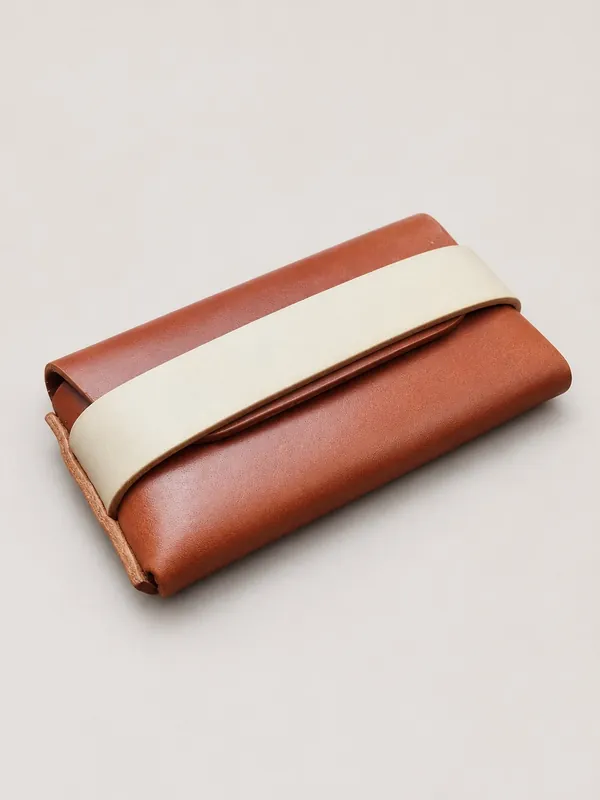
When someone compares the price of an artisan wallet with a cheaper one, the comparison is almost always between their initial prices. But that is only part of the calculation. The cost per use of an artisan wallet or bag is a way to assess the real value of what you buy: not how much you pay on the first day, but how much it costs each time you use it throughout its life. Within this framework, comparing two pieces with very different prices can yield an unexpected result.
What cost per use is and how to calculate it
The formula is simple: cost per use = purchase price / expected number of uses.
If a wallet costs 90 euros and you use it for four years, five days a week, you will have accumulated approximately one thousand uses. Its cost per use is 9 cents. If another wallet costs 30 euros but its construction gives way after a year—stitching coming apart, material peeling, a fastening failing—and you use it at the same frequency during that time, you will have accumulated around two hundred and fifty uses. Its cost per use is 12 cents.
The result surprises anyone who has not calculated it before: the more expensive piece can be cheaper per use than the cheaper one. This is not always the case, and the calculation depends on assumptions that need to be sound. But as a framework for assessing a purchase, cost per use puts the conversation where it belongs: on the value the object gives you over time, not the price you pay just once.
Why the initial price is misleading
An object’s initial price is the most visible figure and the easiest to compare. It also tells you the least about the purchase’s real value. Two wallets with the same price can have completely different useful lives depending on their material, construction and the use they receive. And two wallets with very different prices can cost the same per use if the more expensive one lasts much longer.
The problem is that the initial price communicates clearly (we see it on the label), whereas a piece’s actual durability does not become obvious until it is already too late to change the decision. By the time you see the stitching giving way or the material deteriorating after a few months, you have already paid and already used it.
This explains why many people repeat the cycle: they buy a cheap piece, use it until it fails, then buy another similar one. The cumulative cost of those repeated purchases often exceeds that of a higher-quality piece bought just once, although this calculation is not intuitive when looking only at each individual purchase price.
How to apply the calculation before buying
To use cost per use as a decision-making tool before buying, you need to estimate three variables:
Frequency of use. How many days a week will you use this piece? Not everyone carries the same wallet every day; some alternate between two or three. An honest estimate of how many times a week it will leave the drawer is the first step.
Expected useful life. This is the hardest variable to estimate before buying, because it depends on material, construction, how you use it and the basic maintenance you provide. For a well-constructed artisan piece in vegetable-tanned leather with basic care, the period of regular use may extend over several years, although this depends on each piece and how it is used. For a piece made from more fragile materials or with less solid construction, that period may be months. The available information about the piece’s material and construction helps you make a more accurate estimate.
Purchase price. The number you already know.
With these three variables, the calculation is immediate. And if you are comparing two differently priced pieces, calculating it for both and comparing the results can change which seems the more sensible option.
Two illustrative scenarios
To make the reasoning more concrete, here are two scenarios without brands or specific prices:
Scenario A. A low-priced wallet, bought on impulse. It is used practically every day for seven months, then the stitching starts giving way and the piece becomes unusable. Approximately one hundred and fifty uses. The cost per use is relatively high, although the initial price seemed small.
Scenario B. A higher-priced artisan leather wallet, bought more deliberately. It is used four or five days a week for three years, with basic maintenance: a soft, dry cloth and the manufacturer’s specific guidelines for that finish (for Woodman Studio, the care section). Approximately six hundred and fifty uses. The cost per use is lower than in scenario A, although the initial price is several times higher.
These scenarios are illustrative: the actual numbers depend on each case. But the mechanism is real, and the calculation is valid. The hardest variable to predict is useful life, which in turn depends on construction quality and the care given to the piece.
The assumption that makes the calculation work
Cost per use assumes the piece receives reasonable use and basic maintenance. If it is abandoned in a drawer or used in ways that rapidly damage it—systematically overloading it, exposing it to extreme conditions without protection—the expected useful life is not achieved and the calculation loses validity. This is not a problem with the framework but with its starting assumption: cost per use is a tool for someone who intends to use and care for what they buy, not someone buying without any intention of paying attention to the object.
For leather, the starting point for basic care is simple: a soft, dry cloth when the piece needs it. Any additional treatment—moisture, conditioner, cleaning products—depends on the piece’s particular finish and should only be applied according to the artisan’s instructions, because not all finishes tolerate the same products. For a significant stain, the prudent approach is to request an assessment before applying treatments. Finish-specific details are available in the Woodman Studio care section, and you can always ask the artisan directly.
If you would like to see Woodman Studio’s pieces and learn more about their construction, visit the shop and the Handmade section. For any questions about the materials or construction of a particular model, write to us on WhatsApp or through the contact page.
Frequently asked questions
How do you calculate a wallet’s cost per use? Divide the purchase price by the expected number of uses over the piece’s useful life. For example: an 80-euro wallet used 500 times has a cost per use of 16 cents. To estimate it before buying, you need to know the price, estimate weekly frequency of use, and make a reasonable assumption about useful life based on materials and construction.
Does it make sense to apply cost per use to an artisan bag? Yes, especially when the artisan piece’s initial price seems high compared with cheaper alternatives. Cost per use puts the comparison in the right context: how much the object costs each time you use it throughout its life, not just how much you pay on the first day.
What factors affect a leather accessory’s useful life? The main factors are the type of leather and its tanning process, construction quality (stitching, edges, fastenings), the regular use it receives and the basic maintenance provided. A well-constructed piece in vegetable-tanned leather with regular care has a significantly longer useful life than one made from more fragile materials without maintenance.
What basic maintenance does leather need for the calculation to be valid? The starting point is occasional cleaning with a soft, dry cloth. Additional treatments such as moisture or conditioner depend on the particular finish and should only be applied according to the artisan’s instructions. Details for each piece’s finish are in the Woodman Studio care section, and for a significant stain it is best to request an assessment before treating it.
Where can I see Woodman Studio’s pieces? In the Woodman Studio shop, you can browse the current catalog of artisan leather wallets, bags and card holders. For questions about construction or materials, you can write on WhatsApp or through the contact page.