
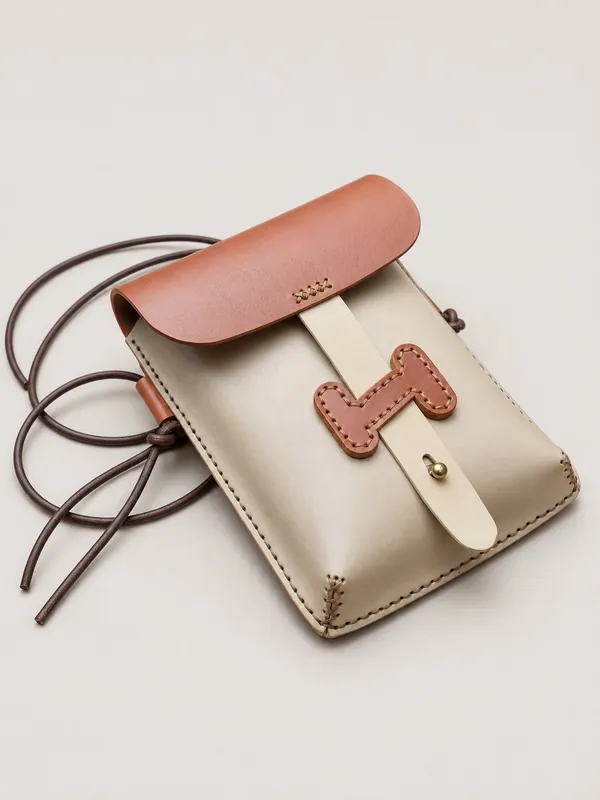
When you are looking for an artisan leather accessory and wondering what changes when you buy it directly from the person who makes it, the most common answer is “quality.” But that answer explains nothing. Buying leather directly from the artisan changes something more concrete: the information you have, the questions you can ask, and the relationship you establish with what you carry. When there are intermediaries between maker and buyer—shops, distributors, platforms with their own margins—something is lost along that chain: not necessarily the quality of the object, but the connection to it and to the process that created it.
This article explains, in concrete terms, what that difference really means.
The price reflects the actual work
In a conventional distribution model, an accessory’s final price accumulates margins all along the chain: the manufacturer’s margin, the distributor’s, the retailer’s. Every link adds something. The result is that the price you pay does not directly relate to the actual cost of making the object, and that gap can be very significant for mid-to-high-priced accessories.
When you buy directly from the artisan, that chain disappears. The price reflects materials, tools, working time and the artisan’s accumulated knowledge. There are no additional layers. This has two important consequences: the artisan can charge fairly for their work without making the final price inaccessible to the buyer, and the buyer can have a clearer idea of what they are paying for and why.
This does not mean prices are low. It means they are honest. A well-constructed piece in vegetable-tanned leather, handmade with quality materials, has a real manufacturing cost reflected in its selling price. In direct artisan sales, the price does not depend on discount strategies or inflated prices made to look reduced: what you see corresponds to what it costs to make. That transparency is a tangible value in itself.
You know exactly who made your piece and how
With many branded accessories, the name visible on the piece does not necessarily belong to whoever made it. Brands subcontract, change suppliers and adjust processes according to volume. There is nothing illegal about this, but it means the label is not always a reliable source of information about what goes into the object.
When you buy directly from an artisan, this does not happen. At Woodman Studio, Oleg designs his models, selects the vegetable-tanned leather, dyes it, shapes it and does practically all the work by hand. That can be verified and explained. You can ask why a piece has a particular thickness, what dyeing process was used, or how the stitching is handled on a specific model. You are not trusting a brand; you are buying the work of a particular person whose identity and process are publicly available in his Handmade section and on his personal page.
This traceability is not just emotional. It also has practical implications: if you ever need information about the material or the specific maintenance of your piece, you can ask the person who made it directly.
Questions only the artisan can answer
There are reasonable questions to ask before buying a leather accessory that very few shops can answer accurately. What tanning process was used for this leather? What was it dyed with? How are the edges finished? What tools were used for the stitching? How long does it take to make this piece?
A shop employee selling products from several suppliers probably does not know the answer to any of them. Not because they are incompetent, but because that information simply is not available at their link in the chain. Product specifications rarely include it, and suppliers do not systematically pass it on to distributors either.
The artisan, on the other hand, can answer all these questions because they made those decisions. They can explain why they chose that thread thickness, how they handled the edge finish on that model, or what happens to the patina of that particular dye after a year of use. This not only helps you make a more informed purchasing decision; it also means that if you own a leather accessory and do not know how to treat it, you can ask whoever made it.
At Woodman Studio, you can ask these questions before buying, directly on WhatsApp or through the contact page. There is no customer service form managed by a third party. There is a person who can answer accurately.
A relationship that does not end with the purchase
Buying from an artisan does not end when you receive the piece. If something needs attention, if you have a care question or simply want to know more about how the piece will evolve with use, you can ask again. Not a customer service department handling issues according to a protocol, but the person who made the object and knows its material and construction firsthand.
This continuity matters particularly with materials such as vegetable-tanned leather, which changes with time and use. Not necessarily negatively: with appropriate use and care, this type of leather usually develops its own patina, distinguishing each piece. But that process can raise questions, and it is more useful to ask someone who knows the material and your piece’s specific finish than to search for generic answers online. For general leather care, the Woodman Studio website also has a dedicated section.
You can browse the current catalog of pieces in the shop. For any questions, write to us on WhatsApp or visit the contact page.
Frequently asked questions
Why does an artisan piece usually cost more than an industrially produced one? An artisan piece requires more working time per unit, individually selected materials and a manufacturing process that does not pursue scale. Industrial production is not inferior by definition; it is a different model with different costs. When buying directly, the cost of artisan work is reflected in the price without the margins added by selling through distributors or shops.
What can I ask the artisan directly before buying? You can ask about the type of leather and its tanning process, how it was dyed, production time, how the stitching is handled, or what maintenance they recommend for that particular finish. The artisan can answer accurately because they made those decisions themselves.
How do I know the piece is genuinely handmade and not simply expensive? You can ask for an explanation of the manufacturing process: what the artisan does with their hands, what tools they use, how long each piece takes. A genuine artisan can describe their process in detail and demonstrate it. It also helps to see images of the workplace or process, such as those Oleg publishes on social media.
Does buying directly offer any advantage in personal service? Yes. When buying directly, you interact with whoever made the piece, not an intermediary. You can ask questions, request specific information and receive precise answers. This direct relationship has no equivalent in a conventional distribution channel, where the available product information depends on what the supplier has told the seller.
Where can I see and ask about Woodman Studio’s pieces? You can browse the catalog of available pieces in the Woodman Studio shop. For questions, you can write on WhatsApp or through the contact page.