
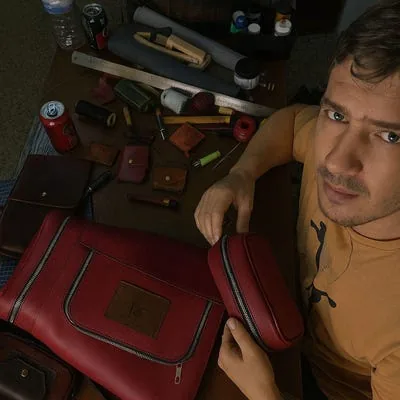
A Woodman Studio wallet or bag does not begin in a factory, or with a template downloaded from the internet. It begins in the mind of Oleg Naumenko: a Ukrainian artisan, designer, and Paralympic fencer who works vegetable-tanned leather almost entirely from the first step to the last. This article explains what that actual process looks like, what it means for a piece to be handmade from start to finish, and what happens between the initial idea and the moment the accessory reaches its buyer.
This is not a manufacturing tutorial. It is the story of a specific working process, with the decisions that make it different from mass production.
Everything begins with design
Before there is leather, there is a model. Oleg designs the pieces he makes. That is no minor detail: it means every model follows its own logic—of proportions, use, and construction—that he has thought through before starting to cut. He does not work from outside patterns or replicate other brands' shapes.
Design in artisan leatherwork is more concrete than it may seem from the outside. It determines the compartment structure, how the leather folds without breaking at the corners, the type of closure that makes sense for that size, and exactly where the stitching goes so the piece can withstand the stresses of daily use. Those decisions happen on paper or in a prototype, before there is any finished piece.
Oleg's visual inspiration has specific roots. The stained-glass windows and historical and Gothic symbols he photographs while walking through cities such as Barcelona and Paris form part of the visual language he is developing for a new line of pieces. That collection is being created and is not yet available; when it is, it will have its own design story to tell.
Vegetable-tanned leather: selection and dyeing
Once the design exists, the material is the second fundamental decision. Oleg works with vegetable-tanned leather, a type of animal leather in which the process of transforming the hide uses extracts from tree bark and plants instead of the chromium salts standard in industrial production. Both are chemical processes—vegetable tannins are also chemical substances; the difference lies in the tanning agent and the character of the result. Vegetable-tanned leather usually has its own distinctive density and firmness, with the ability to develop a patina and respond to care suited to its finish.
What distinguishes Oleg's work at this stage is that he does not receive leather already finished and ready to cut: he dyes it himself. This means each piece's color—the amber tone, dark brown, or deep black seen in the shop's models—is the result of a dyeing process Oleg controls directly. Two pieces dyed at different times will have variations in tone, the natural consequence of a manual process, not a defect.
This control over dyeing also means the piece's color finish is integrated into the manufacturing process, rather than being a surface treatment added afterward. The dye penetrates the leather and becomes part of the material.
From cutting to stitching: decisions at every stage
With the design defined and the leather prepared, construction of the piece begins. Oleg does practically all the work by hand, which has implications at every stage of the process.
Cutting leather by hand requires attention to grain direction and the naturally different areas of each hide. Not every part of a piece of leather is the same: some areas have a higher fiber density and others are spongier, and the artisan decides which parts of the material go into the piece's highest-stress areas.
Stitching is done with two needles and waxed thread, with tension that Oleg adjusts manually at every stitch. This is the traditional method of artisan leatherwork: every stitch is formed by two threads crossing and being tightened one by one. The stitches are highly regular, with the small variations inherent in handwork that distinguish handmade stitching from machine stitching.
The edges—the exposed borders of each piece—are burnished and sealed by hand to close the leather fibers. It is one of the most time-consuming steps and receives the least attention in product photographs, but makes a difference with continued use: a well-burnished edge tends to age well; an untreated edge tends to fray through friction.
The result: a piece bearing traces of the hands that made it
When a Woodman Studio piece is finished, it carries traces of the entire process. This is not a metaphor: hand dyeing produces a tone no machine would repeat exactly, the variations in the leather grain belong to the particular animal that piece came from, and the stitches have the regularity of Oleg's eye and hand, not of a fixed-cycle machine.
This has a practical consequence: two identical Woodman Studio models will not be exactly alike. The same design, the same process, but different pieces. For someone who values the individuality of an object made by a person, that is exactly what they want. For someone who needs perfect uniformity across several units, it is worth knowing before buying.
You can see the available models in the shop and the process in greater detail in the Handmade section. To learn Oleg's story as an artisan and athlete, the About Oleg section has that information. If you have specific questions about the process for a model or want to know a piece's status before ordering, the most direct channel is WhatsApp or the contact page.
Curious about the process behind a particular model? Ask Oleg directly: get in touch now.
Frequently asked questions
Does Oleg make all the pieces himself?
According to the published information, Oleg does practically all the work by hand: designing the models, dyeing the leather, cutting, stitching, and finishing. For any detail about the process for a particular piece, the most direct source is Oleg himself through the contact page or WhatsApp.
What does vegetable-tanned leather mean, and why does Oleg use it?
Vegetable tanning is a process for transforming animal hide that uses extracts from tree bark and plants instead of chromium salts. It produces leather with greater initial firmness that responds well to hand dyeing and develops a patina with use. It is a slower process than chrome tanning, which commonly associates it with artisan production.
Are Woodman Studio pieces available immediately or made to order?
Each model's availability is checked directly. Products can be viewed in the shop, but purchasing currently takes place by inquiry through WhatsApp or the contact page.
What is the new line inspired by Barcelona's Gothic architecture?
Oleg is developing a line of pieces with motifs inspired by stained-glass windows and historical and Gothic symbols he photographs on walks through cities such as Barcelona and Paris. That collection is being created and is not yet available. When it is, it will have its own space on the website.
Will two pieces of the same model be exactly alike?
No, and that is part of the process's nature. Hand dyeing produces variations in tone; vegetable-tanned leather has natural grain irregularities; hand stitching has the regularity of a human eye, not a machine. Two wallets of the same model will be very similar but not identical. Those variations are expected and inherent in artisan work.