
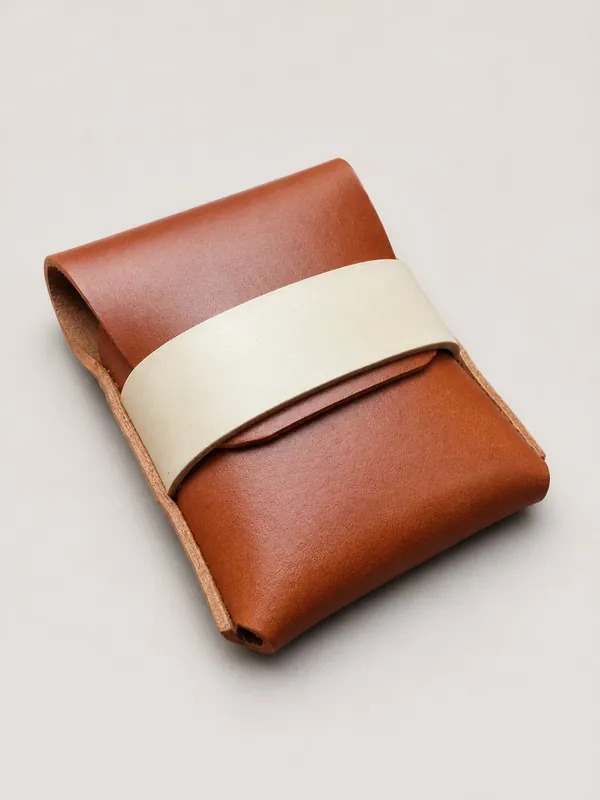
Knowing how to recognize quality in a handmade leather piece is more useful than knowing whether the leather is “genuine.” Genuine leather is the broadest category there is: it includes everything from very low-quality leather to the finest artisan work. What distinguishes a well-made piece from one that merely looks the part is not the label, but the construction.
This guide gives you specific criteria worth checking before buying any handmade leather item: a wallet, a card holder, a bag. They apply whether you buy in person or online, with the difference that in the latter case you depend on photographs and the artisan's willingness to show the details that matter.
Why there is no single test to identify quality
Several popular methods for identifying genuine leather circulate: some discuss water absorption, others how it behaves when bent, others the appearance of the edge. None of these indicators, on its own, determines a piece's quality.
Water absorption, for example, varies enormously depending on the leather's finish. Leather treated with waxes or oils may repel water for a long time, regardless of its intrinsic quality. Assessing quality solely by how it reacts to a drop of water can lead to mistaken conclusions depending on the finish of the particular piece you are examining.
The same applies to flexibility: vegetable-tanned leather is usually stiffer than many chrome-tanned leathers, especially in new pieces, although stiffness also depends on thickness and finish. This is not an indicator of poor quality; it is a characteristic of the tanning process. Comparing both types directly without understanding this difference can lead to confusing a denser material with a less thoroughly worked one.
The real quality of a handmade leather piece is revealed by combining construction clues, not by applying a single test. The following sections give you those clues.
Clues in the material: grain, texture and dye
Animal leather has a natural grain with its own irregularities: variations in tone, subtle hide markings, differences in texture between areas. These imperfections are characteristics of the material, not defects. Leather with an entirely uniform surface may indicate that it has been sanded or corrected to hide marks; this alone is not a verdict on quality, but it is information worth knowing and asking about.
In vegetable-tanned leather, an uncorrected surface clearly shows that natural texture. It is a clue that the original layer of leather has been used, rather than a lower layer that needed correction. But—and this qualification matters—it does not automatically make every irregular-looking leather a high-quality material. Grain is a clue, not definitive proof.
The dye also says something about the process. Unevenly dyed leather, with irregular darker or lighter patches and no visible intention, may indicate careless application. By contrast, evenly applied dye or deliberate gradations—which take time and skill in vegetable-tanned leather—signal that real work has gone into the finish.
The construction that photographs cannot hide
Stitching is the most direct construction indicator and provides the most information at a glance. In a well-crafted handmade piece, stitches are even in length and tension, with small variations characteristic of handwork that differ from the irregularity of careless work. The thread is properly tensioned at every stitch, and the ends are finished so they will not fray with use.
In vegetable-tanned leather, handwork with waxed thread is common and has specific practical advantages: if one stitch breaks, the seam does not unravel in a chain as some industrial machine stitching does. This is a real technical reason why hand stitching matters beyond visual appearance.
Edges are the detail that most distinguishes a carefully made piece from one that is not, and also the most frequently overlooked. The edge of an untreated piece of leather shows its inner fibers, rough and uneven. Burnishing that edge—sealing it with wax, sanding it, going over it several times—is slow work that appears in no cover photograph but determines how the piece ages and feels to the touch.
A properly burnished edge looks smooth, with sealed fibers and no fraying. An unburnished edge that leaves fibers exposed will age less well, may crumble with use and signals that the artisan prioritized production speed over finishing.
The final finishing that completes the piece
Hardware—fastenings, rivets, rings, snaps—should be securely attached and visually consistent with the rest of the piece. Hardware that moves with just a slight pull, or whose finish does not suit the leather's tone, indicates it was chosen for cost or fitted without the necessary care.
The overall consistency of the piece matters too. If the interior is unlined in a model that seems to need lining, or the interior finish is markedly inferior to the exterior, it may be a deliberate design decision—some models are unlined for reasons of thickness and weight—or a sign that steps were cut. It is worth asking if this is unclear.
Finally: the edges of card slots and compartment openings should feel smooth, without sharp edges. A sharp edge that will constantly contact cards inserted and removed several times daily is a finishing oversight that time amplifies.
What makes Woodman Studio's process different
Oleg Naumenko designs each model, selects the vegetable-tanned leather, dyes it and shapes it almost entirely by hand. There is no mass production: each piece passes through the same hands from beginning to end. The visible process—from dyeing to edge finishing—is documented in the website's Handmade section. To meet the artisan and discover the story behind the project, visit About Oleg.
If, when viewing the catalog photographs, you want more detail of a particular element—stitching, edges, a model's interior—you can ask directly. It is the most honest way to assess a handmade piece before buying it. The shop has the available models, and the contact page or WhatsApp are available for pre-purchase questions.
Want to see details of a particular model's stitching, edges or interior before deciding? Write to Woodman Studio, and we will send what you need: get in touch now.
Frequently asked questions
How do I know whether a piece's leather is genuine rather than synthetic?
Genuine leather and synthetic materials behave differently, but identifying them from a photograph alone is difficult. Animal leather shows natural irregularities in grain and texture; synthetics usually look more uniform, with less variation between areas. If you have the piece in your hands, the cut edges of genuine leather show natural fibers; synthetic edges tend to look more uniform and layered. If in any doubt, ask the artisan directly.
Is vegetable-tanned leather higher quality than other types?
Vegetable tanning describes the tanning process, not a quality scale. There is very high-quality vegetable-tanned leather and low-quality vegetable-tanned leather. It is a process that gives leather characteristic firmness and density, with the ability to develop a patina through use, but comparing vegetable-tanned and chrome-tanned leather as “better” or “worse” makes no sense without defining the particular intended use.
What does it mean for leather to “develop a patina” over time?
Patina is the change in tone, sheen and texture that vegetable-tanned leather accumulates through use and contact with skin and the objects it holds. It does not happen in the same way in every leather or with every finish: it depends on the leather type, dye and surface treatment of the piece. It is a characteristic of the material under certain conditions, not a universal promise.
Are surface imperfections a defect in handmade leather?
It depends. Marks inherent in the leather's natural grain—variations in tone, small surface irregularities—are characteristics of the material and do not affect the piece's function or strength. Deep scratches, areas with uneven finishing or stitching defects are a different category. Before buying, it is worth asking the artisan what the photographs show if anything is unclear.
How do I assess the quality of a handmade leather piece when I only have photos?
Look for detailed photographs of the stitching, edges and interior, not just the front view. Stitches should be even, edges burnished without visible fibers, and hardware finished consistently with the leather. If the available photographs do not show these details, ask the artisan for them before buying.