
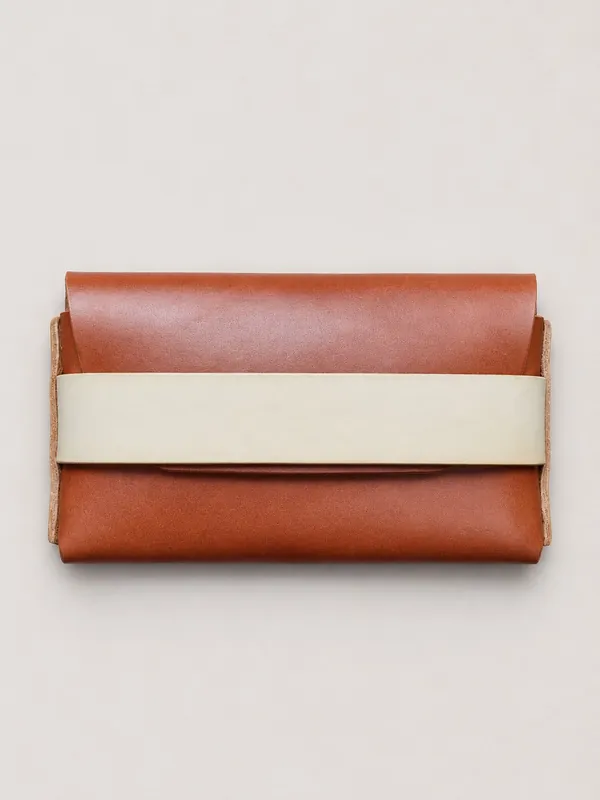
A wallet is one of those accessories used every day, touched many times without thinking, that becomes familiar over time. When it is well made, it stops being a neutral object and becomes part of its owner's everyday kit. Giving a handmade leather wallet can be a particularly good choice—precisely because of that everyday character—or miss the mark completely if you do not consider how the recipient carries their belongings.
The key is not style or price. It is function.
The first criterion: how they usually carry their belongings
Before thinking about colour or model, there is a more important question: how do they organise their belongings when they go out? You do not need to conduct a survey. Simply observe or think back.
Some people carry their wallet in a pocket and need it to be as thin as possible. Others carry it in a bag and care less about thickness than capacity. Some still use cash daily; others carry only two cards and their phone. Each profile points towards a different kind of wallet, and being handmade or made of leather does not change that basic logic.
A compact wallet designed for four or six cards, without a coin compartment, is perfect for someone who keeps things minimal and carries their wallet in a trouser pocket. For someone who handles more cards, needs to separate them by type or still regularly uses cash, a larger-capacity model does the job better. It is not better or worse: it is more suitable for that use.
Size and format: what the recipient's current habits tell you
A practical way to find your bearings without asking direct questions is to observe the wallet your intended recipient currently uses. If they carry a slim wallet that barely shows in their pocket, that tells you a great deal about what works for them. If they carry a bulky one and have been complaining about it for a while, something better organised or more compact would probably help.
Wallets with clearly defined compartments work well for someone who wants to separate things by use without having to search. More open, simpler wallets work better for someone who carries little and values being able to see everything at a glance.
External size matters particularly if the wallet will live in a trouser pocket: in that case, the flatter it is, the better. If it will live in a bag or an inside jacket pocket, there is more room for manoeuvre.
Handmade leather: what changes compared with an industrially produced wallet
The difference between a handmade wallet and a mass-produced one is not just price. It is the process and the long-term result.
In a handmade piece, construction decisions—the leather's thickness, the form of the stitching, how the edges are finished—are made by a person who considers them one by one. It does not undergo the standardisation of an assembly line. That can show in the feel, in the joins and, over time, in how the piece evolves.
Vegetable-tanned leather, which Oleg works with at Woodman Studio, also has a particular characteristic: it usually develops a patina with use. Its appearance does not remain identical to the first day: it gains character. For someone who values that ageing process, this is part of what makes a handmade piece special.
Leather colour: where to start if you are unsure
Colour is probably the detail that most often leaves someone choosing a handmade wallet as a gift feeling lost. The good news is that there are some starting points that simplify the decision.
The natural shades of undyed or lightly dyed vegetable-tanned leather—amber, honey and light chestnut—are the most neutral and work best when you do not know the recipient's exact preferences. They go with most wardrobes and have the material's own visual appeal.
Darker shades—dark brown, black—are equally classic, safe choices, especially if the recipient usually wears dark clothing or prefers accessories that do not draw attention.
If you are unsure, Oleg can advise you on which shade comes closest to what you are looking for, based on the recipient's intended use and overall style.
What to confirm before deciding
Before placing your order, there are three aspects worth checking directly:
Model availability. The Woodman Studio catalogue is handled through enquiries, and pieces are made by hand. Confirming that the model you are interested in is available—or when it could be ready—is the first step before committing.
Timescale. If the wallet is for a specific date—a birthday, anniversary, Christmas—communicate that from the beginning. Oleg does practically everything by hand, which can mean different timescales from those of an industrially produced item held in stock.
Price. For the exact price of a specific model, the most direct approach is to ask when you enquire.
You can see the wallet catalogue in the Woodman Studio shop. For guidance on the most suitable model for the recipient's use, write to Oleg via WhatsApp or the contact page. This is the channel he uses to answer enquiries and help with choosing.
Frequently asked questions
Is a handmade wallet a good gift for someone who already has a wallet? Yes, as long as the new one is better suited to their use than their current one. If the person carries a bulky wallet they are unhappy with, a more compact, well-made version may be exactly what they need. If they already have a wallet that works very well for them, a card holder might be a more useful complementary option.
How do I know which wallet size is most suitable? Observe how they usually organise their belongings. How many cards do they carry? Do they use cash? Do they carry it in a trouser pocket or a bag? Those answers point towards the most useful format. If you are unsure, Oleg can help you identify the model that fits best.
Does vegetable-tanned leather require special care? For everyday care, the safest choice is a soft, dry cloth. Any cleaning with moisture or use of conditioners should be reserved for the artisan's instructions and depend on compatibility with each piece's finish. For a significant stain, ask for an assessment before applying any treatment. You can consult Woodman Studio's care section.
What is the difference between a card holder and a compact wallet? A card holder is designed to carry only your most-used cards, without space for cash or additional compartments. A compact wallet usually includes some space for banknotes and perhaps a pocket, but in a small format. For someone who carries very little, a card holder may be enough; for someone who needs a little more, a compact wallet offers greater versatility.
Can a wallet be personalised with initials or a date? This is something worth asking Oleg directly, as the services available vary. Write to him via WhatsApp or the contact page to find out which options are available at that time.